


- 01Stock-picker market; disciplined selectivity.
- 02Rates up; liquidity tight; multiples compress.
- 03MQG case: volatility tailwind; $7.5b surplus.
February earnings season has marked a decisive shift in the investment landscape. Growth remains, but capital is no longer abundant, and policy support has receded.
Simply following momentum in the hope of easy gains is no longer sufficient. We have transitioned into a true stock picker’s market, where disciplined, selective, and prudent portfolio construction is increasingly critical.
The Reserve Bank of Australia’s move to lift rates to 3.85% reinforces that inflation is proving persistent rather than transitory. Liquidity is tighter, funding costs are structurally higher and valuation multiples are less forgiving.
In this environment, markets are placing a premium on cash conversion, balance sheet strength and demonstrable returns on capital over expansion driven by cheap financing.
This concluding edition of our high conviction series turns to a cohort of names where pricing power and operational discipline underpin earnings resilience.
With the economy expected to expand by 1.8% to 2.3% in 2026 and unemployment near 4.3%, demand remains intact but uneven, particularly across housing, energy transition and discretionary segments.
Against that backdrop, we assess Macquarie Group (ASX: MQG), Origin Energy (ASX: ORG), Qantas Airways (ASX: QAN), West African Resources (ASX: WAF), Perseus Mining (ASX: PRU), Vault Minerals (ASX: VAU), Aeris Resources (ASX: AIS), alongside the niche industrial and retail operators Capral (ASX: CAA), IVE Group (ASX: IGL) and Universal Store Holdings (ASX: UNI).
Each reflects our emphasis on cash backed earnings, prudent capital management and identifiable catalysts in a market increasingly rewarding execution over narrative.
Financial Services: Volatility as opportunity
Macquarie Group (ASX: MQG)
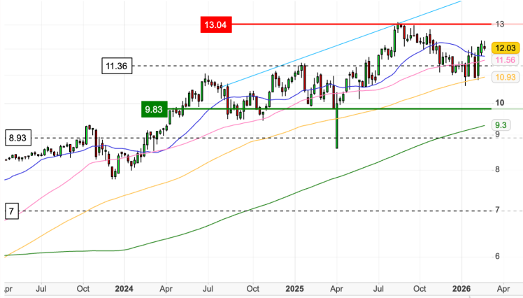
Source: MQG, weekly chart (2026)
Macquarie Group continues to demonstrate that volatility can be an earnings tailwind rather than a headwind. In the 3Q26 update, the Commodities and Global Markets division delivered a notable uplift, benefiting from heightened activity across gold, copper and energy markets. We see this as evidence of a platform built to intermediate risk when others retrench.
With a $7.5bn capital surplus, the balance sheet provides considerable optionality, whether in energy transition assets, digital infrastructure or selective bolt on opportunities. The deliberate exit from non-core exposures further sharpens that focus, reinforcing what we regard as a fortress balance sheet framework in an unsettled global environment.
A defining feature of the investment case remains the structural tilt toward private capital. With $736.1bn in assets under management and a private credit book of $28.9bn, scale is meaningful.
As traditional bank lending tightens under regulatory and capital constraints, Macquarie’s Private Markets arm is stepping into the gap, deploying $5.7bn in the most recent quarter alone. This expansion into private credit and infrastructure debt captures durable yields in a higher for longer rate setting and diversifies income streams beyond traditional market linked activity.
For us, that blend of asset management, specialist lending and capital markets capability reduces earnings cyclicality and enhances resilience.
The stock has begun 2026 with constructive momentum, breaking out from a recent consolidation range and holding above key long-term moving averages. We interpret this as a reassessment of the quality and durability of earnings, particularly the annuity style infrastructure and private markets income. As the market increasingly values stable cash generation alongside exposure to secular themes such as decarbonisation and data centre growth, Macquarie offers a rare mix of blue-chip defensiveness and structural growth. That balance underpins our high conviction stance within the portfolio.
Energy Transition: Balancing stability and optionality
Origin Energy (ASX: ORG)
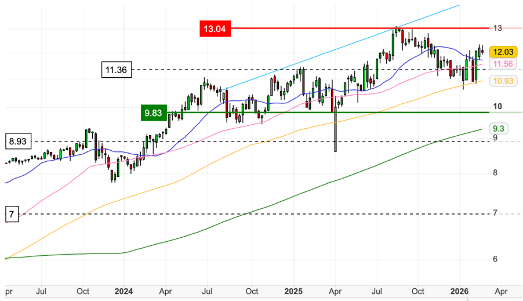
Source: ORG, weekly chart (2026)
Origin Energy has managed a complex regulatory and operational backdrop with increasing confidence. The upgrade to FY2026 Energy Markets EBITDA guidance of $1,550mn to $1,750mn reflects both the lagged pass through of higher wholesale electricity prices into retail tariffs and a $100mn to $150mn cost reduction programme that is running ahead of plan.
The extension of the Eraring Power Station to April 2029 is strategically important. It supports grid reliability at a critical juncture, smooths depreciation and creates a bridge toward large scale battery deployment. In effect, Origin is monetising legacy coal cash flows while accelerating its transition toward a lower carbon generation mix.
The Integrated Gas division remains the financial anchor. Australia Pacific LNG is expected to deliver cash distributions of $700mn to $950mn in 2026, underpinning liquidity and supporting adjusted free cash flow that recently reached $705mn.
With net debt to EBITDA at 2.0x, the balance sheet is materially stronger than in previous cycles. That resilience allows Origin to sustain a 30 cent fully franked interim dividend while funding 1.7GW of battery expansion and continuing to invest in Octopus Energy and the Kraken platform.
We see this as a differentiated proposition: a defensive utility income stream complemented by structural upside from its 22.7% exposure to the global Kraken licensing ecosystem.
The stock has regained upward momentum, moving back above key long-term averages following a period of consolidation. We interpret this as a reassessment of earnings durability after the guidance upgrade. Trading at what we estimate to be a 10% to 15% discount to intrinsic value, the risk reward remains compelling. A dividend yield near 5%, reduced uncertainty around Eraring and the planned mid 2026 separation of technology assets together provide identifiable catalysts. In our view, Origin combines income, transition optionality and balance sheet strength in a way that justifies high conviction positioning within the portfolio.
Aviation: Returns in a higher cost world
Qantas Airways (ASX: QAN)
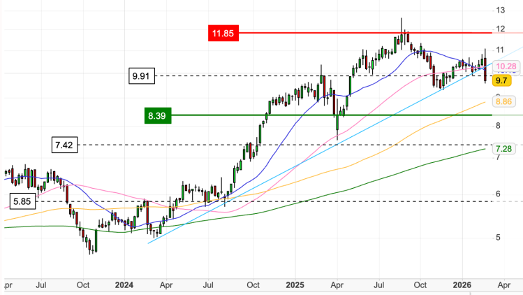
Source: QAN, weekly chart (2026)
Qantas Airways has emerged from the pandemic as a leaner and more disciplined carrier, with performance metrics that now compare favourably against global peers. For FY2026, forecast net profit of $1.8bn and a projected dividend of 35 cents per share mark a clear return to active capital management.
What stands out to us is the 23% Return on Capital Employed, close to 2.5 times the industry average, underpinned by the dual brand structure of Jetstar and the resilience of the Loyalty division. Sustained 10% to 12% growth in Loyalty EBIT reduces reliance on cyclical passenger yields and fuel swings, giving the earnings base a more diversified character than most airlines can claim.
The next chapter is capital intensive. A $20bn fleet renewal programme will introduce more fuel efficient A321XLR and A350 aircraft as part of Project Sunrise, a strategic necessity in the face of rising labour costs and volatile fuel inputs.
Same Job Same Pay legislation is expected to add around $115mn in FY2026, while fleet transition expenses of roughly $160mn create near term pressure. The crucial metric for us is balance sheet discipline, with management targeting Net Debt to EBITDA of 2.0x to 2.5x through the delivery cycle.
Against that backdrop, the anticipated $400mn in annual transformation savings and the structural benefits of a younger fleet support the longer-term return profile.
Looking at the charts, the stock has been consolidating within a defined range and is holding above long-term support levels. We see early indications of a broader reversal pattern forming, particularly as momentum indicators stabilise. On a forward multiple of about 8.4x and with a dividend yield near 5%, valuation appears undemanding relative to earnings power and brand strength. With travel demand resilient and corporate volumes gradually normalising, we see Qantas as a high-quality value opportunity that combines operational recovery with disciplined capital allocation and improving technical momentum.
Precious and Industrial Metals: scarcity as a structural theme
West African Resources (ASX: WAF)
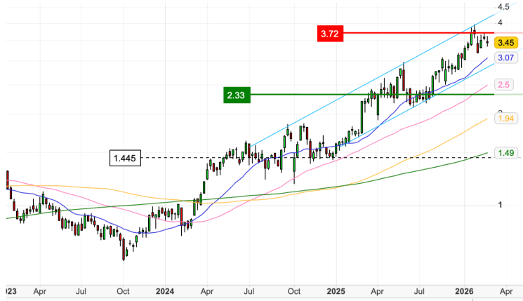
Source: WAF, weekly chart (2026)
West African Resources has evolved into a pure, unhedged exposure to bullion at a time when gold prices have surged toward record territory near US$5,000 per ounce. The Q4 2025 result illustrates the torque embedded in the model, with an average realised price of $4,058 per ounce and A$389mn in operating cash flow.
The ramp up of Kiaka, delivered ahead of schedule and under budget, is central to the next phase of growth and moves the group toward its 500,000-ounce annual production ambition.
By remaining 100% unhedged, every incremental move in the gold price flows directly through earnings, giving us high beta exposure to the strength in the underlying commodity.
Operational longevity is increasingly supported by drilling success at Sanbrado and Kiaka. Recent intercepts at M5 North and M1 South, including 28m at 6.1 g per tonne, confirm that mineralisation extends beyond current reserve boundaries.
Together with the Toega satellite development, this underpins a production profile that could peak near 569,000 ounces in 2029. Jurisdictional concentration in Burkina Faso inevitably carries risk, yet consistent delivery, with production guidance met or exceeded for five consecutive years, strengthens confidence.
In our assessment, operational execution and community engagement mitigate part of that sovereign overlay.
The stock has broken higher from a consolidation base and continues to trade well above long term moving averages. Momentum indicators remain constructive, with a sequence of higher lows reinforcing the broader uptrend. With all in sustaining costs near US$1,561 per ounce and a cash balance of $584mn, margins and liquidity are sector leading. That financial strength provides flexibility to fund expansion while preserving optionality for future capital management. For us, the blend of organic growth, unhedged leverage and balance sheet resilience supports a high conviction stance within the gold allocation.
Perseus Mining (ASX: PRU)
Source: PRU, weekly chart (2026)
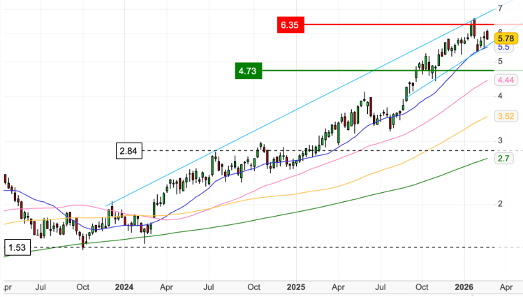
Perseus Mining stands out in the mid-tier gold universe for the strength of its balance sheet. With US$755mn in net cash and no debt, we see a company operating from a position of genuine financial flexibility. Q2 FY2026 production of 88,888 ounces reflected a temporary soft patch at Yaoure, yet cash margins remained robust at US$1,637 per ounce.
Edikan and Sissingue provided important offsets, with production up 17% and 60% respectively. Management’s decision to hold full year guidance of 400,000 to 440,000 ounces, while lifting AISC guidance to US$1,600 to US$1,760 per ounce to reflect higher West African royalties, signals a pragmatic response to cost inflation rather than an attempt to mask it.
The longer-term growth vector is anchored by the Nyanzaga project in Tanzania, targeting first gold in January 2027. With US$262mn already committed and major construction components such as SAG and ball mill fabrication progressing ahead of schedule, visibility toward a group production rate above 500,000 ounces per annum by FY2028 is strengthening.
The commencement of first ore from the CMA underground development in January 2026 also marks the start of a higher-grade feed phase at Yaoure, supportive of margin resilience. Crucially, this pipeline is being funded from internal cash generation, enabling a US$100mn buyback alongside ongoing development spend without recourse to external capital.
PRU has delivered strong medium-term gains and is now consolidating after a period of outperformance. Momentum indicators remain constructive, with support levels holding despite near term volatility around quarterly production. On a forward multiple of roughly 15.1x, well below the broader peer cohort, and with a free cash flow yield near 10.5%, valuation does not appear to fully capture the transition toward a multi asset, multi decade producer. As the production profile weights more heavily to the second half, we see scope for the earnings trajectory to become clearer, underpinning our high conviction stance within the gold allocation.
Vault Minerals (ASX: VAU)
Source: VAU, weekly chart (2026)
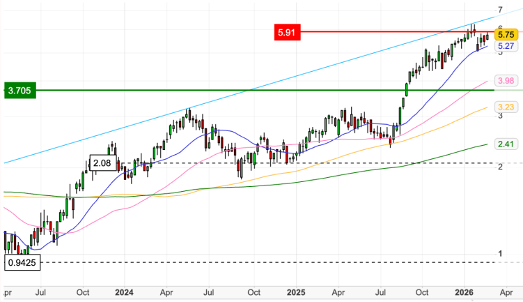
Vault Minerals has repositioned itself as a high beta exposure to bullion after closing out its hedge book six months ahead of schedule in late 2025. By settling forward sales early, the group entered 2026 largely unhedged, leaving forecast production of 332,000 to 360,000 ounces fully exposed to elevated Australian dollar gold prices.
With realised prices recently near A$4,582 per ounce against year-to-date AISC of A$2,865, margin expansion has been pronounced. Supported by cash reserves of more than A$500mn, the narrative has shifted from balance sheet consolidation to a step change in free cash generation as King of the Hills and the Deflector owner operator transition move toward steady state output.
Capital management adds a further layer to the investment case. The on-market buyback of up to 10% of issued capital signals management’s conviction in intrinsic value, particularly with earnings forecast to compound at roughly 21% per annum over the next three years.
The Stage 1 expansion of the King of the Hills processing plant, due for commissioning by the end of March, is expected to lift throughput capacity and operational reliability. With forecast Return on Equity of 21.5%, we see Vault combining production growth with disciplined capital returns, a pairing that is often elusive in the mid-tier gold space.
Vault has recently retraced from 52-week highs but continues to trade within a broader upward channel and above long-term moving averages. We interpret the pullback as consolidation rather than structural weakness. On a forward multiple of around 24x, supported by near 19.4% earnings growth expectations and full exposure to spot gold pricing, valuation appears aligned with growth and leverage characteristics. Upcoming catalysts, including the plant expansion commissioning and the February 2026 exploration update across Leonora and Mount Monger, provide further scope for operational momentum to translate into sustained equity strength, reinforcing our high conviction stance.
Aeris Resources (ASX: AIS)
Source: AIS, weekly chart (2026)
Aeris Resources has taken a decisive step toward scale with the $214mn acquisition of Peel Mining, completed on February 12. The consolidation of the Cobar Basin brings the high-grade South Cobar Copper Project alongside Tritton, lifting group copper resources to 981,000 tonnes.
Mine life across the NSW complex extends by up to a decade and a pathway emerges toward annual production of roughly 30,000 tonnes. With structural copper demand strengthening on electrification and grid expansion themes, the timing enhances leverage to a supportive commodity backdrop.
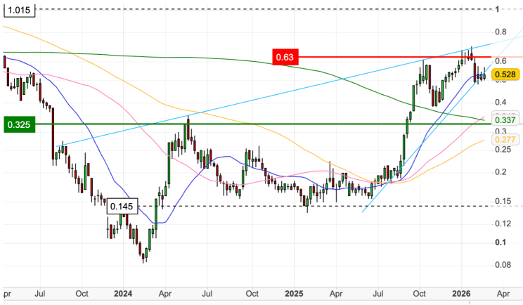
The balance sheet has been reset in parallel. An $80mn placement and share purchase plan in late 2025 enabled full repayment of a $40mn debt facility, leaving the group effectively debt free with $106mn in cash and receivables. That clean financial position materially lowers execution risk as Peel assets are integrated and advanced.
On a pro forma market capitalisation near $851mn, Aeris is approaching the threshold for inclusion in the ASX 300, a development that could broaden institutional ownership and liquidity over time.
Aeris has consolidated following a period of exceptional outperformance over the past year. Momentum indicators have moderated without signalling excess, suggesting room for a renewed advance as integration milestones are met. On roughly 11x earnings and with a free cash flow yield near 22%, valuation remains undemanding relative to the embedded growth optionality. As the Peel transaction is absorbed and production scales, we see a compelling alignment between operational expansion and financial discipline, supporting our high conviction stance within the copper allocation.
Niche Industrials and Retail: Cash generation and repricing potential
Capral (ASX: CAA)
Source: CAA, weekly chart (2026)
Capral has consolidated its standing as the country’s leading aluminium extruder by shifting decisively up the value chain. Central to that strategy is its LocAl lower carbon range, which carries a footprint of six tonnes of CO2 per tonne of aluminium, materially below prevailing global averages.
The commercial rationale is straightforward. As building codes and procurement standards increasingly favour lower embodied carbon, Capral is capturing specification driven demand across residential, commercial and industrial projects, while insulating margins from swings in primary aluminium pricing.
The group’s national distribution footprint reinforces that advantage. Domestic scale and established customer relationships present a formidable barrier to offshore suppliers contending with freight costs and tightening decarbonisation expectations. The result is a structural tilt toward higher value, sustainability aligned revenue rather than pure commodity exposure.
Capral reported revenue of $686 million for the 12 months to 31 December 2025, representing a 6% increase on FY24 revenue of $650 million. The uplift was largely driven by higher average London Metal Exchange (LME) prices and a more favourable sales mix, which more than offset a 4% decline in volumes to 65,000 tonnes (FY24: 67,800 tonnes).
Underlying EBITDA rose 2% to $59.6 million, while underlying EBIT improved 4% to $35.8 million, up from $34.3 million in the prior year. Reported net profit after tax (NPAT) increased 10% to $35.6 million, compared with $32.5 million in FY24.
FY25 NPAT benefited from the resolution of a long-standing insurance claim worth $3.0 million, alongside a $2.5 million tax benefit following the recognition of additional deferred tax assets.
On a per-share basis, basic earnings per share (EPS) rose 14% to $2.15 (FY24: $1.88), while net tangible assets (NTA) per share increased 13% to $12.72 (FY24: $11.25).
The company declared an unfranked final dividend of $0.30 per share, bringing total shareholder returns — including on-market buy-backs - to $0.85 per share for FY25, up 12% from $0.76 in FY24.
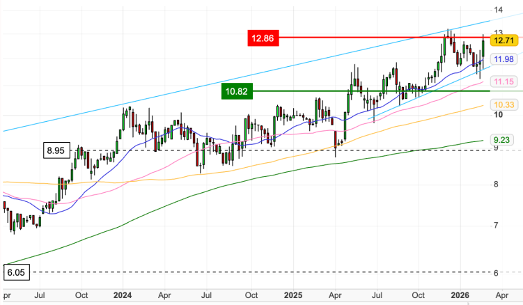
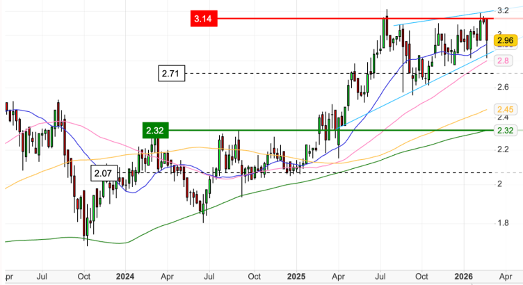
On valuation, the shares trade on a P/E of 6.39x, a marked discount to both book value of $14.18 per share and to broader industrial peers. Recent weakness toward $11.74 has brought the price close to technical support around $11.51, within a longer-term uptrend that has seen the stock outperform the ASX 200 by more than 20% over the past year. In our view, the market has yet to fully price in Capral’s 40% plus domestic market share and the earnings leverage embedded in its lower carbon product mix. The February 26 result is the near-term catalyst that could narrow that gap as investors reassess the durability of its cash generation profile.
IVE Group (ASX: IGL)
Source: IGL, weekly chart (2026)
IVE Group is advancing its Now to 2030 agenda with a measured shift from legacy print toward integrated marketing services. The $35mn acquisition of Daily Press, completed on December 31, 2025, marks a significant stage in that transition. By adding Daily Press’s proprietary Indy SaaS martech platform and its social and performance marketing capabilities, IVE is moving further upstream into strategy and creative execution, areas that command structurally higher margins than traditional production.
The transaction, expected to contribute roughly $23mn in annual revenue and to be immediately earnings accretive, broadens the group’s claim on client marketing budgets. It also strengthens IVE’s ability to offer a unified digital and physical solution, countering the steady erosion in print volumes by embedding the company more deeply in campaign planning and data driven marketing.
For a fragmented sector, that integrated model is increasingly difficult for smaller operators to replicate.
Attention now turns to the H1 FY2026 results due on February 25. Investors will seek evidence that the expanding digital footprint is supporting earnings resilience rather than merely offsetting print weakness.
Capital management remains a key pillar of the investment case. A $10mn on market buy back sits alongside a trailing dividend yield of about 5.77%, with a payout ratio near 60%, suggesting distributions remain supported by underlying cash flow.
The integration of Daily Press and the earlier JacPak acquisition will also be scrutinised for delivery of the targeted $1mn in annual cost synergies through in sourced print and distribution.
On valuation grounds, the shares trade on a forward P/E of around 10.4x, a level that appears undemanding given the improving mix of earnings and disciplined capital returns. The stock has gained 43% over the past year and is holding above both its 50 day and 200 day moving averages, indicating sustained investor sponsorship. Relative to the ASX 200, performance has been notably stronger, yet the rating still implies scepticism about the durability of the transformation. Should upcoming results confirm margin stability and integration progress, there is scope for that discount to narrow as the market reassesses IVE’s evolution from print operator to diversified marketing platform.
Universal Store Holdings (ASX: UNI)
Source: UNI, weekly chart (2026)
We see Universal Store Holdings consolidating its position in domestic youth apparel with a tightly curated, brand led model that is beginning to show clear operating leverage. The H1 FY2026 result, released on February 19, marked a decisive shift from last year’s margin pressure. Statutory net profit rose 150.4% to $28.3mn, reflecting both the absence of prior impairments and a sharper execution across buying and inventory. In our view, this was less a rebound and more a reset.
Operationally, the numbers point to discipline. Gross margin expanded 150 basis points to 62.1%, while underlying EBIT increased 23.2% to $43.6mn. Return on equity at 25% underscores pricing power in a segment where many peers have relied on discounting to defend volumes.
The balance sheet strengthens the case: $38.4mn in net cash and no bank debt provide flexibility as store rollout accelerates. Early H2 trading, with DTC sales up 13.5% and Perfect Stranger up 39.0%, suggests momentum is carrying forward. Private label penetration, with Neovision at 19% of core sales, adds structural support to margins.
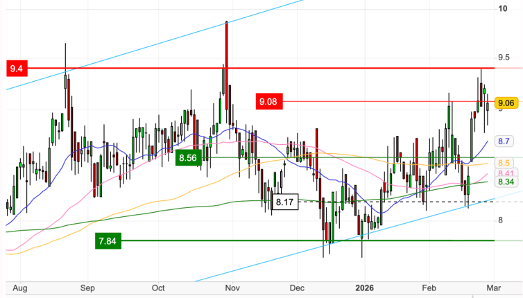
From a valuation perspective, we acknowledge the rerating. Shares have moved through the $9.05 to $9.25 range, above January highs, yet the 26.0 cent fully franked interim dividend, up 18.1%, keeps the yield between 4.3% and 4.7%. Trading above the 200-day moving average, the stock now has fundamental confirmation behind it. As margins stabilise and new formats gain traction, we see a credible pathway toward the $10.20 to $10.40 target range.
Discipline as the Enduring Edge
The common thread across the companies covered is not thematic variety but financial resilience. Whether through capital markets intermediation, energy transition cash flows, aviation recovery, unhedged gold leverage, copper scale or disciplined retail execution, each converts strategy into measurable returns and balance sheet strength.
The macro backdrop remains constructive yet exacting. Growth of 1.8% to 2.3% and unemployment near 4.3% imply demand is intact, but the 3.85% rate setting enforces capital discipline. Liquidity is selective, and valuation support rests increasingly on free cash flow, not narrative.
Our framework therefore remains consistent. We prioritise businesses that compound internally, protect margins, sustain dividends or buy backs and retain flexibility for reinvestment.
In a market recalibrated to higher capital costs, durability of cash generation is the ultimate differentiator.
***For over a decade, we have successfully managed Growth, Income, and Balanced portfolios for self-funded retirees and time-poor professionals. To learn more about our HIN-Direct wealth management services, please contact me at ++mark.elzayed@investorpulse.com.au***++
Get the wire before the market opens.
The ASX small-cap stories that matter, filed before 9am AEST. Curated by the Small Caps desk.