
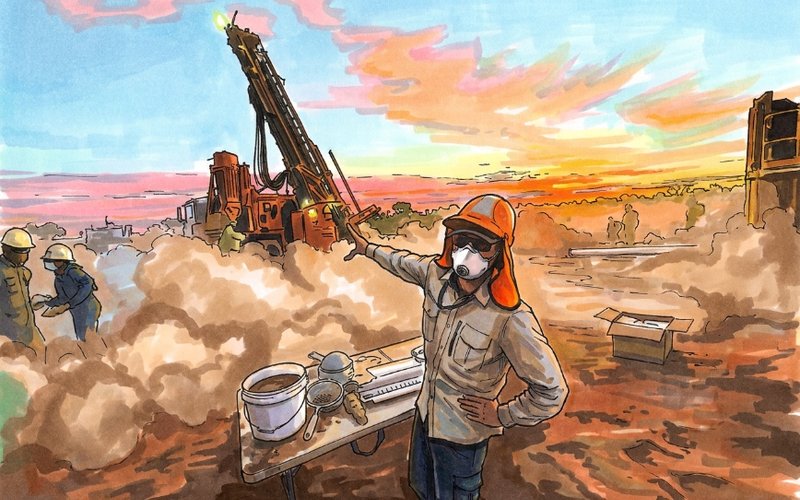

- 01Kuro Mn: high-grade, near-surface.
- 0221 RC holes; 10>20% Mn; best 13m@34.9% (incl 10m@42.3%, 1m@54.4%).
- 03IP targeting supports discovery; more drilling planned.
Trek Metals (ASX: TKM) has confirmed a high-grade, near-surface manganese discovery at the Kuro prospect within its wholly owned Christmas Creek project in Western Australia through the first laboratory assays from maiden drilling.
The initial batch from 21 reverse circulation (RC) drill holes returned 10 holes grading above 20% manganese and 15 holes with intervals above a 5% manganese cut-off.
The standout result was 13m at 34.9% manganese from 13m, including 10m at 42.3% manganese from 13m and a peak one-metre assay of 54.4% manganese.
Other high-grade intersections included 4m at 44.6% manganese from surface, 11m at 24% manganese from 6m, 13m at 19.9% manganese from 24m, 11m at 19.3% manganese from 9m, and 8m at 25.4% manganese from 8m.
The assays verify that high-grade mineralisation previously identified at surface continues below ground and support further work across a broader interpreted prospective basin.
Grade Continuity Established
The five thickest intersections contained between 8m and 15m of contiguous mineralisation above cut-off, with all significant intervals occurring between surface and 37m down-hole.
Samples grading at least 20% manganese averaged 2.7% iron and 0.04% phosphorus for a manganese-to-iron ratio of about 13:1, rising to 47:1 in the highest-grade interval, but no metallurgical or product characterisation test work has been completed.
“The thing that I find most encouraging about the Kuro manganese discovery is the regional context,” chief executive officer Derek Marshall said.
“Kuro is just one prospect area—one that we initially targeted as there was a small window of rocks sticking out of the ground in a region where most of the rocks are under shallow sand cover.”
“We have a large interpreted basin to explore and we are doing just that, with the Moombarriga crew continuing their surveys to identify future drill targets to determine where the RC rig goes next.”
Effective Targeting Method
Induced polarisation (IP) surveying has emerged as an effective targeting method at Kuro, where chargeability anomalies beneath shallow sand cover have led drilling to concealed high-grade manganese without surface expression.
Gradient array IP surveying is continuing north-east of the discovery area within an interpreted prospective basin extending for about 16km.
Earthmoving has started at Kuro and the Coogan copper-gold target, while Trek is preparing sub-audio magnetic surveying over the Martin high-grade gold prospect and a regional airborne magnetic-radiometric survey.
Remaining Phase 1 assays are expected over the next three to five weeks, with further Kuro drilling anticipated after the results and additional IP data have been reviewed.
No Mineral Resource has been estimated at Kuro and further drilling and evaluation will be required to determine whether the exploration results can support one.
Get the wire before the market opens.
The ASX small-cap stories that matter, filed before 9am AEST. Curated by the Small Caps desk.