
Resolution Minerals (ASX: RML) has started diamond core drilling at the Golden Gate area of its Horse Heaven antimony-tungsten-gold-silver project in Idaho, USA, while reporting strong initial gold recoveries from metallurgical test work.
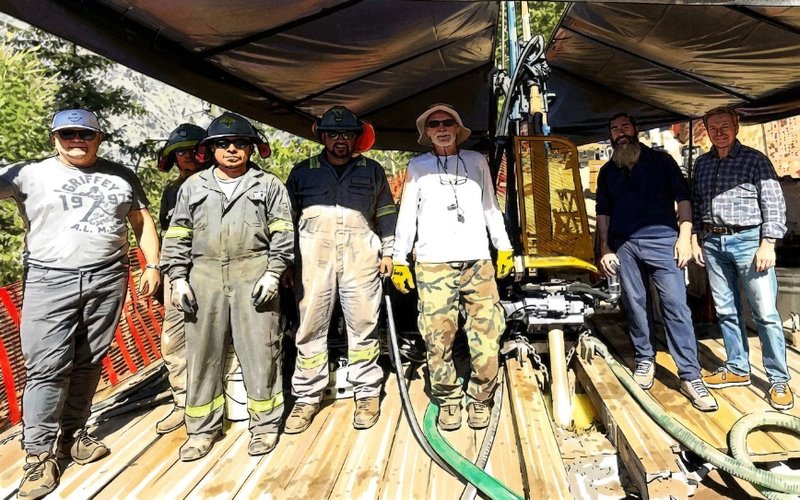
An MP1500 diamond core drill rig has commenced the first hole of the 2026 Golden Gate program, which is planned to comprise up to 13,700 metres across as many as 45 holes.
The program is targeting tungsten and gold mineralisation at Golden Gate, which sits immediately adjacent to Perpetua Resources’ Stibnite gold project.
Initial metallurgical test work on Golden Gate composite drill core samples has returned gold recoveries of 94% to 95% from oxide leach tests and 86% to 88% from sulphide flotation tests.
Large Drill Program Underway
Resolution has designed the 2026 Golden Gate program to define the scale and extent of gold mineralisation at Golden Gate North and Golden Gate South.
The program will also test extensions of the broader system after previous drilling returned strong gold intersections from surface and ended in mineralisation.
A key follow-up target is hole HH-GG25-001C, which returned 189.2m at 1.30 grams per tonne gold from 34.1m to 223.4m.
Drilling will also assess tungsten mineralisation around previous Golden Gate mine workings and at Golden Gate South, where a 500m by 600m target hosts a coincident gold and tungsten soil anomaly.
Historical Tungsten Production
Golden Gate has historical tungsten production, with the most recent mining occurring in 1980.
Composite samples from stockpiles stored at the Johnson Creek mill site have assayed 1.85% tungsten trioxide.
The current drilling is intended to identify extensions of tungsten mineralisation around the previous mine workings and test the broader tungsten anomaly at Golden Gate South.
Resolution’s mapping shows the Golden Gate gold and tungsten targets forming part of a broader Horse Heaven project area that also includes Antimony Ridge.
Gold Recovery Results
Independent Metallurgical Operations in Perth conducted the initial test work on two Golden Gate composite samples prepared from 2025 diamond core.
Gold-bearing oxide samples with a composite feed grade of 0.55g/t gold were subjected to direct cyanide leaching.
The tests returned 94.2% gold extraction at a grind size of 150 microns (µm) and 95.5% extraction at 75µm after 24 hours of leaching.
After 48 hours, residue grades were 0.04g/t gold and recoveries ranged from 92.7% to 93.8%.
Sulphide Flotation Testing
Gold-bearing sulphide samples with a composite feed grade of 1.91g/t gold were subjected to rougher flotation testing.
A 106µm grind size returned 86.4% recovery and produced a combined gold grade of 49g/t.
A finer 75µm grind size increased recovery to 88.7%, although the gold grade decreased to 26.4g/t due to higher silica recovery.
Further test work will now focus on reagent optimisation, with rougher, regrind, and cleaner testing after that to determine the optimum concentrate grade and recovery.
Composite Sample Work
The sulphide composite represented material below the supergene zone and weighed 63.9kg.
The oxide composite weighed 21.4kg, and was taken from shallower material expected to have undergone significant weathering.
Qualitative mineralogy by Diamantina Laboratories found the sulphide sample was approximately 90% quartz and more than 5% mica, with fresh sulphides including pyrite and arsenopyrite representing around 0.5%.
The oxide sample was predominantly quartz with less than 10% sericitic mica and possible kaolin, with scanning electron microscopy detecting goethite, jarosite, scheelite, monazite, pyrite and antimony-iron oxide inclusions.
Board and Investor Site Visit
Resolution’s board and major investors have visited the Horse Heaven project and witnessed the first drill hole of the season.
The site visit included Golden Gate, the Johnson Creek mill, and Antimony Ridge.
Horse Heaven comprises 729 US federal lode mining claims covering 14,580 acres.
The project area is dominated by Cretaceous-aged granitic rocks associated with the Atlanta Lobe of the Idaho Batholith, with gold, antimony, tungsten, and silver mineralisation associated with hydrothermally altered and fractured granodiorites.
