
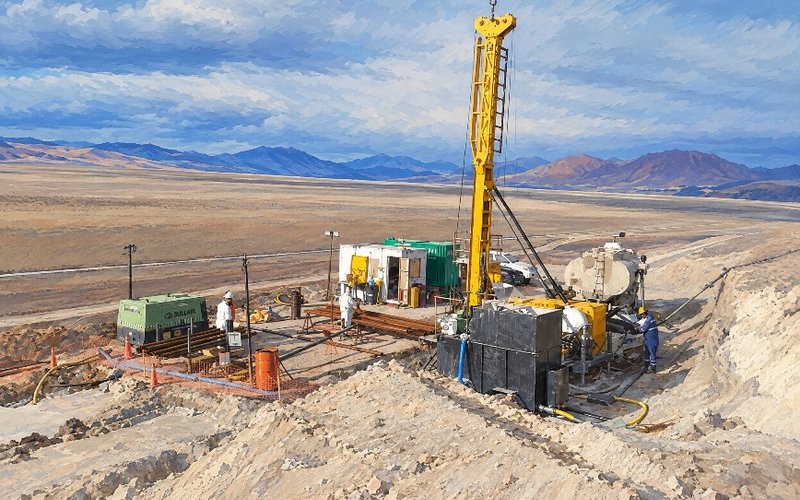

- 01Record 995mg/L brine assay at Rio Grande Sur, 23% above prior high.
- 02DDH-3 ended in mineralisation; results will inform a resource update.
Pursuit Minerals (ASX: PUR) has recorded its highest lithium brine concentration at the Rio Grande Sur project in Argentina, with final assays from drilling at the Mito tenement reaching 995 milligrams per litre (mg/L).
The peak result from DDH-3 exceeds the previous 809mg/L assay by 23%, while several other samples returned concentrations above 900mg/L in the deeper part of the hole.
The results come from the northern Rio Grande Salar, where the company is assessing whether additional high-grade brine can increase the size and average grade of its existing mineral resource.
DDH-3 reached approximately 560 metres and ended in lithium-bearing mineralisation, leaving the lower limit of the system unresolved.
Deep Brine Results
Packer testing across selected intervals of DDH-3 returned four individual assays above 900mg/L, including 964mg/L, 943mg/L and 922mg/L alongside the 995mg/L peak.
Eight samples exceeded 800mg/L, with the stronger results concentrated across separate intervals between roughly 400m and 510m below surface.
The highest assay came from an interval between 444.2m and 445m, while a further result of 827mg/L was recorded beyond 509m, indicating lithium enrichment across multiple tested depths.
The assays measure concentrations in individual brine samples rather than the average grade of a mineral resource, and the extent and continuity of comparable concentrations elsewhere remain to be established.
Pursuit collected the brine through a packer-testing program targeting selected geological units, building on preliminary results released in September.
Resource Growth Assessment
Rio Grande Sur currently hosts a mineral resource containing 1.264 million tonnes (t) of lithium carbonate equivalent (LCE) at an average lithium concentration of 424mg/L.
The estimate comprises 705,000t of LCE in the Indicated category grading 443mg/L and 559,000t in the Inferred category grading 405mg/L, providing the baseline for the planned revision.
Pursuit intends to incorporate geological, hydrogeological, and brine chemistry information from DDH-3 and DDH-4 at Demasia into the updated resource model.
“The final results from DDH-3 are an exceptional outcome for Pursuit, delivering the highest lithium grades ever recorded at Rio Grande Sur,” managing director Aaron Revelle said.
“To encounter multiple samples of this grade at depths exceeding 400 metres is particularly significant and reinforces our confidence in the scale, quality, and long-term development potential of the project.”
Development Studies and Testing
Work is continuing on addendums to the Rio Grande Sur pre-feasibility study, covering expanded lithium carbonate and lithium chloride development pathways beyond the initial planned 5,000tpa operation.
The company is preparing infrastructure for approved pilot plant evaporation ponds at Sal Río II as it relocates its pilot plant to the project for testing under field conditions.
A 30-day continuous pumping test at María Magdalena is targeted for 2027 to improve hydrogeological modelling and inform future well-field planning.
Pursuit is separately preparing further induced polarisation surveys and an initial drilling program at its Sascha Marcelina gold project, subject to weather, site access and contractor availability.
“Combined with the ongoing exploration program, we believe these results represent a major step forward in unlocking the full scale and value of the Rio Grande Sur project,” Mr Revelle added.
Get the wire before the market opens.
The ASX small-cap stories that matter, filed before 9am AEST. Curated by the Small Caps desk.