
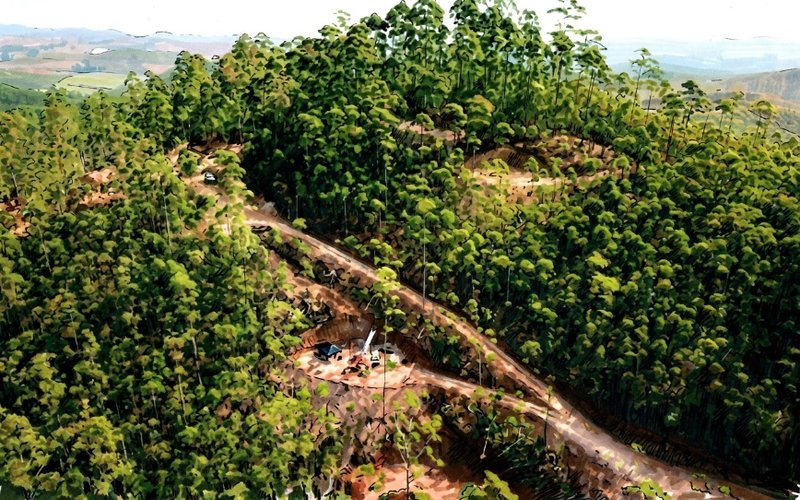

- 01Maiden drill hits thick, high-grade REE zones at Morro do Ferro.
- 02Best: 108.55m @ 4.15% TREO; 29.25m @ 9.01% TREO w/ MREO.
- 03Two magnetite stockwork zones; potential early mining.
Power Minerals (ASX: PNN) has intersected thick, high-grade rare earth (REE) mineralisation in maiden drilling at the Morro do Ferro project in Brazil’s southern Minas Gerais state.
The upper portion of the campaign’s third hole delivered a best assay of 108.55 metres at 4.15% total rare earth oxides (TREO) from surface, including a project record of 1.45m at 4.4% mixed rare earth oxides (MREO).
A section of 29.25m at 9.01% TREO with 1.32% MREO of whole rock from surface to 35m and 6.45m of 9.34% TREO with 2.87% MREO, plus 0.5% of whole rock yttrium oxide, 0.1% dysprosium oxide and 360 parts per million erbium oxide was also recorded.
That interval included gadolinium at an outstanding concentration of 1,989ppm, positioning it among the world leaders in this category, and a best reliable gallium result to date of 2m at 124.5ppm from 62m.
Geological logging, supported by iron content in the drill core analyses, showed two zones with stockwork and magnetite veins that are expected to be easy and economical to remove using magnetic separators during the early stages of any future mining operation.
Enhanced Analysis
Power is in currently in discussions with a commercial laboratory on the best method to obtain more accurate and reliable gallium analyses from Morro do Ferro when associated with high concentrations of REEs.
An independent study by South Australian consultant SA Radiation has also looked into the project’s thorium and uranium content utilising specific activity calculations for whole rock geochemical analyses of drillcore samples.
The study confirmed that the deposit’s thorium content sits in Brazil’s lower-risk Category II radiation group, which comprises concentrations of naturally occurring radioactive material (NORM) from 100 becquerels per gram to less than 500Bq/g.
The Morro do Ferro mineralisation is hosted in bastnaesite (a rare earth carbonate) while thorium is hosted in different mineral assemblages capable of deportment during mining and processing.
Pattern of Mineralisation
Chief executive officer Alistair Stephens said the latest results continue the pattern of broad, high-grade mineralisation discovered in the campaign’s first two holes.
“The peak interval of 4.40% MREO, together with elevated levels of dysprosium, terbium, and other heavy rare earths, highlights the potentially strategic character of the rare-earth basket at Morro de Ferro,” he said.
“Just as importantly, the limited deeper assays received to date indicate that mineralisation may continue beyond the depths previously tested.”
“While considerable work is yet to be done — including the remaining assays, mineralogical studies, metallurgical testing, and resource definition — we believe it is emerging as an increasingly compelling rare earth project.”
“We intend to advance it methodically, responsibly, and with strong technical discipline.”
Get the wire before the market opens.
The ASX small-cap stories that matter, filed before 9am AEST. Curated by the Small Caps desk.