

- 01On track to meet 0.5 Mlb/yr forecast from Lance restart.
- 02CPP ramp to 2 Mlb/yr; MU-4 central to restart.
- 03RO plant to fix wash water; operational in 6 weeks.
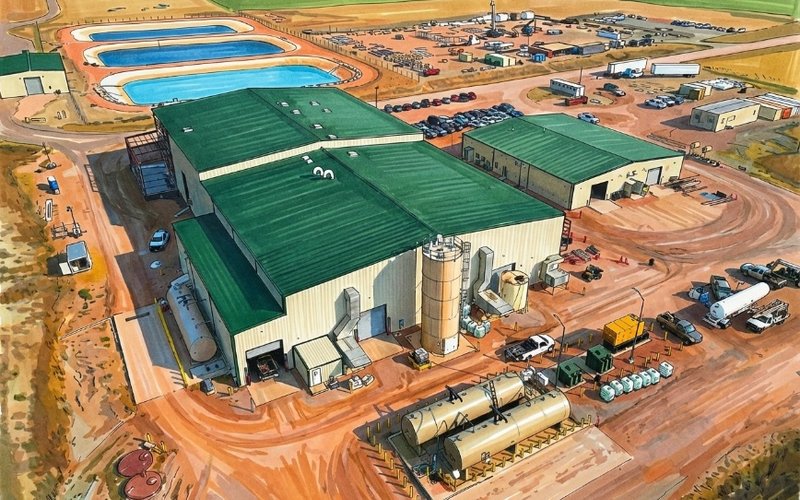
Peninsula Energy (ASX: PEN) and wholly-owned subsidiary Strata Energy have confirmed they remain on track to meet forecast uranium production guidance of up to 0.5 million pounds this year from the mothballed Lance project in the US.
The company is finalising commissioning and ramp-up of the project’s central processing plant (CPP) to its annual production capacity of 2Mlb, and is accelerating development of Mine Unit 4 (MU-4) which represents approximately 60% of the forecast figure and remains central to its production restart plans.
The plant’s dual precipitation circuits, which are used in the final stages of dried yellowcake production, are temporarily offline following installation-related issues with the agitator assemblies.
Replacement kits have been ordered for both circuits and are expected to be on site within seven weeks for installation and re-commissioning, during which time the Phase 2 ion exchange and elution tanks will also be re-coated.
Site Water Quality
Peninsula has ordered a small reverse osmosis (RO) plant to improve water quality for the wash cycle on the CPP plate and frame filter presses.
Water at the Lance site currently has elevated sodium and chlorides, which leads to above-specification levels of these elements in the final dried yellowcake product.
The installation of an RO plant for process water represents a simple, low-cost solution to resolve this issue and achieve the required product specification.
The plant is expected to be operational within the next six weeks and the disruption is not expected to impact Peninsula’s forecast production guidance.
Prior to the issue being identified, the precipitation circuit had achieved an average efficiency of 99% since operations commenced in September.
Wellfield operation and fluid circulation continue uninterrupted, preserving integrity and supporting the company’s ramp-up activities.
Header House Acidification
The acidification process at Header House 14 (HH-14) commenced in late December and is scheduled for completion this month ahead of schedule.
The current pH level has reduced to an average of 2.46 SU (standard units) and uranium-rich solution from the house is expected to be redirected to the CPP this month to allow first uranium to be captured on resin from MU-4.
Encouraging uranium grades are already being reported, with a peak daily head grade from one production well of 352 milligrams per litre and five recovery wells (or 16% of all wells) achieving more than 50mg/L.
Acidification at HH-16 is advancing ahead of plan, with average pH levels declining to 4.53 SU after only three weeks, and HH-15 acidificaiton is expected to commence next month in line with the planned MU-4 development sequence.
Flow rates from production wells in HH-14 and HH-16 have been recorded at 12.4 gallons per minute, exceeding the average of 12 GPM used in the reset plan production forecast.
Project Restart Plan
Lance was one of the largest independent uranium operations in the US before its closure in 2019 on the back of low commodity prices and lower-than-expected recovery rates.
After five years on haitus, Peninsula launched a restart plan to bring the project back online, changing it from an alkaline-based in-situ recovery (ISR) operation to a low-pH (acidic) ISR development and establishing the company as a fully-independent end-to-end producer of yellowcake.
“While installation-related issues have been identified within the precipitation circuit during commissioning, the team has responded quickly to identify the cause and implement a clear rectification plan,” chief executive officer George Bauk siad.
“I would like to commend the Peninsula team for their hard work throughout this commissioning phase as we continue our ramp-up to become a key domestic supplier of uranium within the US.”
Get the wire before the market opens.
The ASX small-cap stories that matter, filed before 9am AEST. Curated by the Small Caps desk.