
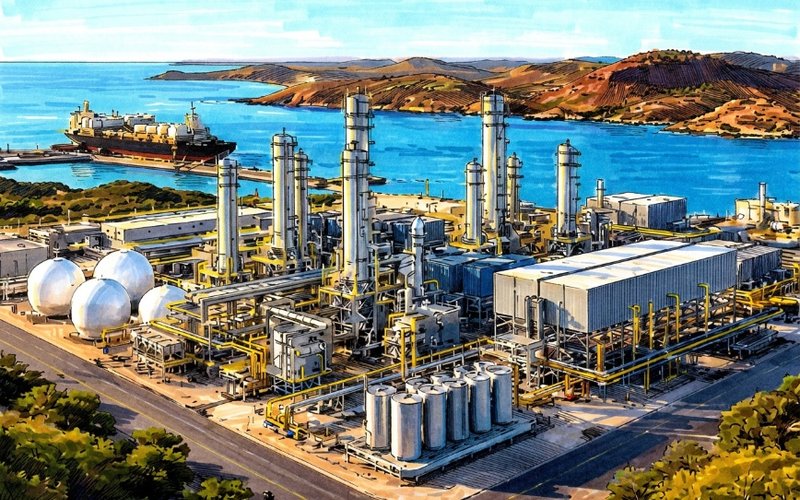

- 01Surveys complete for WAH2 at Maitland SIA.
- 02No threatened flora/fauna detected.
- 03Data support approvals; de-risking; APAC low-emissions ammonia.
NH3 Clean Energy (ASX: NH3) has completed and reviewed the environmental surveys required to support state and commonwealth approval referral submissions for its WAH2 Project in Western Australia.
The work identified no threatened flora or threatened ecological communities within the proposed plant site or associated water supply pipeline survey areas.
The project development envelope (PDE) is dominated by common and widespread Pilbara habitats and vegetation communities with strong regional representation, providing a baseline for impact avoidance, mitigation, and environmental management.
Completion of the survey program marks a key step towards primary environmental approvals as NH3 advances engineering, commercial, and financing activities for the low-emissions ammonia development.
Environmental Baseline Defined
Pilbara Ecological and Eco Logical Australia completed basic, targeted, and detailed flora, vegetation, and fauna assessments in accordance with Environmental Protection Authority technical guidance.
The work covered the proposed Maitland Strategic Industrial Area (SIA) plant site, its water supply pipeline corridor and the broader Maitland to Burrup infrastructure corridor.
Flora and vegetation assessment recorded four Department of Biodiversity, Conservation, and Attractions (DBCA) Priority 3 flora taxa and two vegetation types considered analogous to Priority 1 and Priority 3 Ecological Communities.
No conservation-listed fauna species were recorded at the plant site, while the pipeline survey identified two DBCA Priority 4 fauna species and the regional corridor work recorded priority flora, priority ecological communities, and one migratory bird species.
Approval Planning Support
NH3 considers the environmental values within the project area and surrounding regional setting generally consistent with the broader Pilbara and Roebourne Plains landscape.
The results will inform the approvals application and guide avoidance measures, mitigation planning, and the environmental management approach as project design develops.
Preliminary cultural heritage information for key parts of the WAH2 footprint indicated no critical constraints within the PDE, although detailed cultural heritage surveys remain planned.
“The company has consistently focused on derisking all elements of the project and the selection of the pre-designated development site in the Maitland SIA was part of that strategy,” chair Charles Whitfield said.
“Nevertheless, having completed the environmental surveys on not only the plant site but also the logistics routes for imputs and outputs without any environmental issues being identified is a major milestone for any Australian project.”
Low-Emissions Ammonia
WAH2 is NH3’s flagship development for supplying low-emissions ammonia to Asia-Pacific markets including Japan and South Korea, as well as decarbonised bunker fuel for bulk carriers transporting Australian iron ore to Asia.
Earlier work completed the scoping and preliminary feasibility studies, secured an option to lease the preferred WA government project site, and progressed conditional commercial arrangements for project inputs and offtake.
Front-end engineering design studies have commenced for the current development phase, which also targets unconditional input and offtake agreements before a final investment decision (FID).
NH3 is targeting FID by the end of 2026 as the environmental approvals workstream moves alongside the project’s engineering, commercial, and financing activities.
Get the wire before the market opens.
The ASX small-cap stories that matter, filed before 9am AEST. Curated by the Small Caps desk.