

- 018-month DHS extension; ~A$1.05m for design and scale.
- 02Faster imaging, easier manufacture, deployment-ready.
- 03NEX tech enables self-screening and standalone use.
Micro-X Limited (ASX: MX1), through its US subsidiary Micro-X Inc., has signed an eight-month contract extension with the Department of Homeland Security Science and Technology Directorate (DHS S&T), valued at approximately A$1.05m, to advance its Miniaturised CT Baggage Scanner towards manufacturing at scale.
The extension will fund the design, construction, and delivery of an upgraded scanner incorporating improvements identified through prototype manufacture and testing, with the program to be undertaken across Micro-X’s US and Australian operations.
Development will focus on faster imaging to improve potential passenger throughput, simpler manufacturing for more efficient volume production, and design changes intended to make deployment and operation easier.
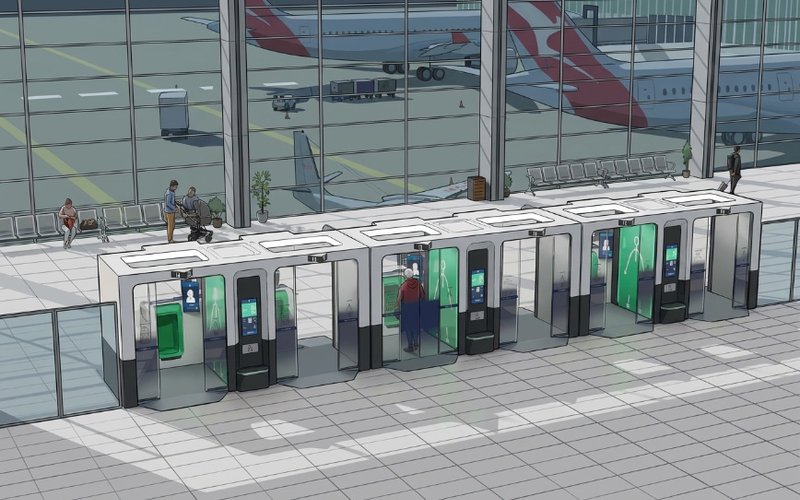
The work is intended to move the Miniaturised CT Baggage Scanner closer to a commercial product configuration while continuing to support development of the Passenger Self-Screening Checkpoint.
Targeting Commercial Design
Micro-X delivered its first prototype Miniaturised CT Baggage Scanner to DHS S&T in 2024 under a funded development program aimed at demonstrating the technology required for the passenger self-screening checkpoint.
It subsequently built three more prototype scanners as part of three fully integrated checkpoint booths, with the four scanners based on the same initial design.
Later DHS S&T funding concentrated on developing and integrating the broader checkpoint, while the prototype scanners were successfully evaluated and used to collect images from thousands of test bags.
The latest extension specifically funds Micro-X to implement and demonstrate improvements identified through that testing, including increasing imaging speed and redesigning elements not originally intended for volume manufacture.
Micro-X expects the resulting changes to improve production efficiency and simplify deployment as the scanner moves closer to a configuration suitable for commercialisation.
Standalone Security Opportunity
Built on Micro-X’s proprietary NEX Technology, the Miniaturised CT Baggage Scanner forms the core enabling technology within the self-screening checkpoint.
Its compact and modular architecture also gives the scanner potential as a standalone product for airports and other security environments where conventional baggage scanning systems can be constrained by size, weight, and infrastructure requirements.
“DHS’s continued investment means we can further develop this technology while retaining the opportunity to apply the scanner both within the Self-Screening Checkpoint and as a standalone security screening product,” chief executive officer Brian Gonzales said.
“This is consistent with our strategy of leveraging development programs with the US government to mature our core NEX Technology into products with broader commercial applications.”
Get the wire before the market opens.
The ASX small-cap stories that matter, filed before 9am AEST. Curated by the Small Caps desk.