
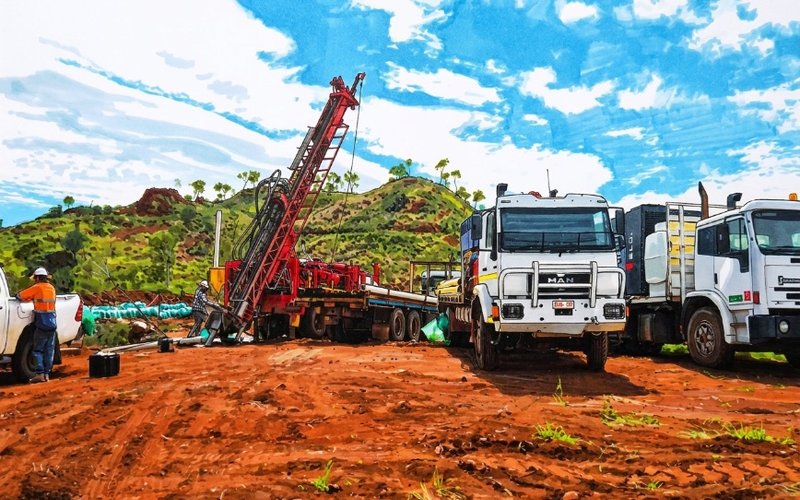

- 01Phase 3 at Oonagalabi: thick Cu-Zn zones.
- 02Best intercepts: 68m, Cu 0.62%, Zn 1.44%, Ag 4.3 g/t.
- 03Magnetic targets persist; more drilling to refine geometry.
Litchfield Minerals (ASX: LMS) has identified thick copper-zinc mineralisation in Phase 3 drilling at its Oonagalabi polymetallic project near Alice Springs in the Northern Territory.
The company completed a total of 11 reverse circulation holes for 1,772 metres and three diamond holes for 1,217.9m across the Bomb-Diggity, VT1, VT2, and Main Zone targets.
Broad-to-narrow zones of mineralisation were encountered at Main Zone, with several holes intersect confirming lateral and vertical continuity of mineralisation within the zone.
Minor copper sulphides intersected at VT1 suggest the potential for a new style of mineralisation, while assay results for hole OGDD003 are still pending from the laboratory.
Best Drilling Intercepts
The company reported a best combined intercept of 68.26m at 0.62% copper, 1.44% zinc and 4.3 grams per tonne silver from 10m including intervals of 19.66m at 0.66% copper, 2.58% zinc and 5.6g/t silver from 10m, and 14m at 0.52% copper, 1.55% zinc and 6.1g/t silver from 36m.
Additional highlights were 120m at 0.92% zinc, 0.35% copper and 4.1g/t silver from 52m comprising intervals of 60m at 0.52% copper, 1.26% zinc and 6.3g/t silver from 52m, as well as 15m at 0.20% copper, 0.98% zinc and 2.1g/t silver from 122m.
Magnetic anomalies at Bomb Diggity and Main Zone were also tested by diamond drilling and continue to represent strong exploration targets, with further interpretation expected to improve the company’s understanding of the target geometry and assist in determining the source of the magnetic response.
The anomalies potentially represent discrete intrusions that were not intersected during drilling, or could more broadly represent numerous intrusions and sills at Oonagalabi.
Using a better constrained geological model, relatively small changes in drill position, or target geometry could result in significant differences in geological outcomes when testing discrete magnetic bodies at depth.
Improved Geological Understanding
Managing director Matthew Pustahya said the drilling campaign had challenged the team at every turn.
“From significant weather disruptions and access issues through to personnel changes and the complexities of drilling a highly deformed mineral system, not everything went to plan,” he said.
“Despite this, the campaign has improved our understanding of the Oonagalabi mineral system and generated several important vectors for future exploration.”
“While this campaign generated as many questions as answers, each result has contributed to a better understanding of the system [and] collectively, these datasets are helping us build and refine the geological model—which we believe is critical to unlocking the full potential of the Oonagalabi region,” he said.
“The combination of broad base metal mineralisation, multiple mineralisation styles, unresolved geophysical anomalies, and emerging regional-scale targets continues to support our belief that Oonagalabi remains a highly compelling exploration opportunity”.
Get the wire before the market opens.
The ASX small-cap stories that matter, filed before 9am AEST. Curated by the Small Caps desk.