

- 01Oonagalabi drilling resumed to test copper-zinc extensions.
- 02New Harts Range licence adds Sybil and Illogwa Creek targets.
- 03Rock chips submitted; ground EM surveys proposed.
Litchfield Minerals (ASX: LMS) has advanced copper exploration across its Harts Range holdings in the Northern Territory while restarting drilling at the Oonagalabi Main Zone.
The September quarter brought a new exploration licence covering about 384 square kilometres, along with field observations of potential copper-bearing minerals at the previously undrilled Sybil target.
At nearby Illogwa Creek, reconnaissance identified sulphide-bearing rocks that will help guide further geological and geophysical investigations.
Drilling at Oonagalabi commenced on 12 October, following preparations during the quarter to test extensions and the geometry of previously identified copper-zinc mineralisation.
New Copper Targets
The Harts Range 1 licence was granted on 30 July and includes Sybil, about 33.6 kilometres southeast of Oonagalabi, where historical exploration identified electromagnetic responses and surface copper indications.
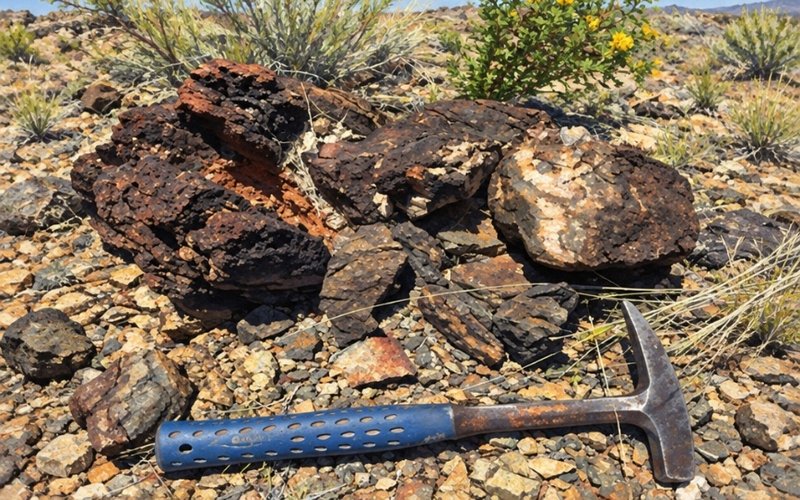
September reconnaissance encountered staining visually interpreted as malachite and disseminated sulphides provisionally identified as chalcopyrite and pyrite around the Sybil conductor areas.
At Illogwa Creek, field work mapped sulphide-bearing mafic rocks along a shear zone, with interpretations suggesting the structure may have links to deeper magmatic pathways.
Litchfield submitted 19 rock chip samples from the two prospects for laboratory analysis and proposed ground EM surveys to refine the next exploration targets.
Oonagalabi Drilling Underway
The Oonagalabi campaign was planned to examine extensions of the Main Zone, clarify structural controls and test new areas within the mineralised system.
The program envisaged approximately seven to 11 holes, with the eventual number dependent on conditions, drilling progress and the available campaign window.
Previous drilling at the Main Zone returned broad intersections including 68.26 metres grading 0.62% copper, 1.44% zinc, and 4.3 grams per tonne silver from 10m.
Final results from the earlier Phase 3 campaign included a separate 5.3m intersection grading 0.64% copper, 0.67% zinc, and 2.2g/t silver from 49.5m.
The company additionally undertook magnetotelluric and gravity surveying near Oonagalabi to investigate an interpreted deep conductivity anomaly, although no survey results were available for the quarter.
Silver Valley Reassessed
At Silver Valley, an initial three-line induced polarisation survey identified weak western chargeability responses but failed to define a discrete high-priority drilling target.
Litchfield consequently stopped after three of five planned lines to reconsider the survey layout alongside geological mapping rather than continue with a potentially misplaced program.
Selective rock chip sampling from dumps beside historical workings returned grades including 470g/t silver, 19.2% copper and 23.2% lead, but these samples cannot establish representative grades or mineralisation continuity.
The next phase will combine further mapping with the geophysical interpretations to determine whether revised IP lines could better test the western structural corridor.
Litchfield finished September with $4.0 million in cash after spending $250,000 on exploration during the quarter, providing resources for its planned field programs.
Get the wire before the market opens.
The ASX small-cap stories that matter, filed before 9am AEST. Curated by the Small Caps desk.