
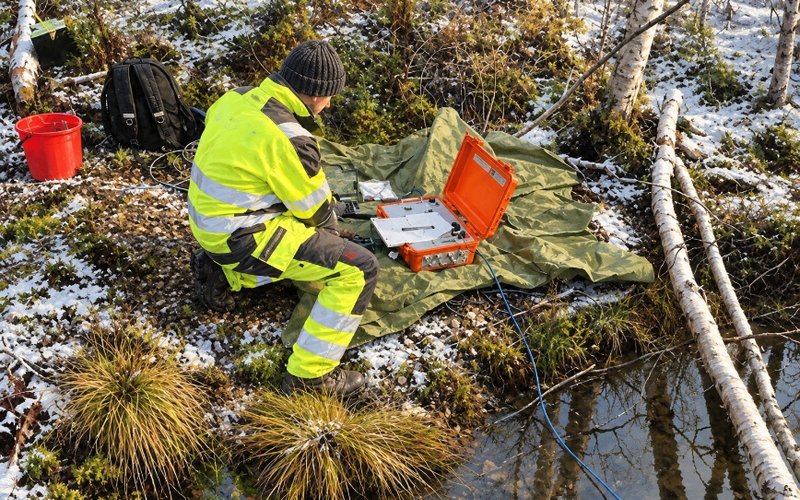

- 01LAT begins 2,500m K1 drilling in Finland.
- 02Conductors target extensions; historic hit: 5.6m at 7.3g/t.
- 03KSB holds 650,000oz gold, 5,840t cobalt; PFS underway.
Latitude 66 (ASX: LAT) has commenced diamond drilling at its KSB gold-cobalt project in northern Finland, targeting extensions to the K1 deposit that could expand its existing mineral resource.
The approximately 2,500-metre program will investigate conductive targets beside and beyond K1, where geological interpretation and historical gold intersections indicate potential continuation of the mineralised system.
The wider project hosts a mineral resource of 7.3 million tonnes grading 2.7 grams per tonne gold for 650,000 ounces of gold, alongside 5,840t of cobalt at 0.08%.
The new campaign is focused on targets immediately northwest and southeast of K1, where geological and structural interpretations have identified fold-controlled settings comparable with the existing deposit.
Drilling is proceeding alongside a pre-feasibility study that will examine development options following completion of a scoping study considering both open-pit and underground mining at K1.
Conductive Plates
Two fixed loop electromagnetic surveys identified conductive plates that provide targets for drilling, with the main modelled conductor extending approximately 320m along strike and as much as 650m down-dip.
Historical drilling near the margins of that conductor returned gold intersections including 5.6m at 7.3g/t, 2.3m at 4.1g/t and 3.5m at 2.6g/t, strengthening the case for testing the surrounding ground.
Those intersections do not establish that the conductors contain continuous mineralisation, making the current holes important in determining whether the known K1 system extends beyond its resource envelope.
“With drilling now underway at KSB, we are moving quickly to test what we believe are some of the most compelling resource growth targets identified around the K1 deposit to date,” managing director Grant Coyle said.
“If drilling confirms that these conductors represent extensions of the K1 mineralised system, there is clear potential to materially grow the existing resource.”
Cobalt Main Contributor
K1 contains 5.8Mt grading 2.7g/t gold for 510,000 ounces and 5,010t of cobalt, making it the principal contributor to the broader KSB resource.
Approximately 79% of the K1 tonnage is classified as Indicated, giving the deposit a substantial higher-confidence resource component within the broader three-deposit inventory.
The resource also incorporates the K2 and K3 deposits, providing a wider inventory against which additional mineralisation identified near K1 could be assessed.
The September scoping study outlined a standalone open-pit and underground development concept, identifying near-mine resource growth as a potential means of improving project scale and longevity.
Parallel WA Work
The PFS is progressing while drilling examines opportunities to increase the resource base, allowing exploration results to inform subsequent development planning.
Latitude 66 regards the targeted conductors as prospective because their geophysical responses coincide with favourable structural interpretations and historical mineralisation rather than relying on geophysics alone.
In Western Australia, the company is advancing its Laverton gold project, which includes the Red Dog and Tin Dog deposits with a combined mineral resource of 339,000 ounces of gold.
That WA inventory provides a second development focus while the KSB campaign tests whether extensions around K1 can increase the scale of the Finnish asset.
Get the wire before the market opens.
The ASX small-cap stories that matter, filed before 9am AEST. Curated by the Small Caps desk.