
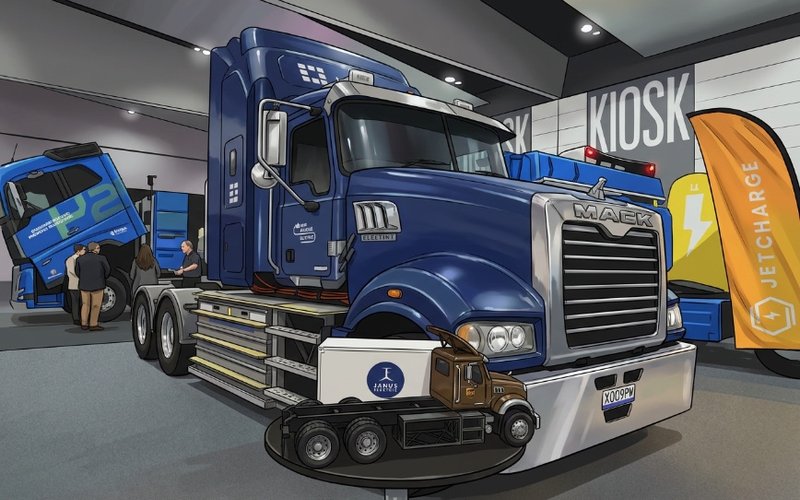

- 01JNS converts diesel trucks to electric.
- 02Six-day retrofit; 4-min swaps.
- 0328 trucks in Oz; US/Canada orders 118.
Janus Electric (ASX: JNS) is an Australian transport technology company focused on decarbonising heavy road freight through its proprietary electric conversion system and exchangeable battery technology.
Rather than requiring fleet operators to replace existing diesel trucks with new electric trucks, Janus converts existing vehicles to electric power, providing a lower-cost pathway to electrification while maintaining the utilisation and operating requirements of heavy transport fleets.
The company was established to provide a practical pathway for heavy fleet operators to transition existing diesel prime movers to electric power.
Its model centres on converting trucks, typically around the point at which a major diesel engine rebuild would otherwise be required, and supporting them through a network of rapid battery exchange stations.
With its technology proven in commercial operations, Janus is now focused on scaling deployment, with trucks operating in Australia and orders and commitments for 118 conversions across the US and Canada.
Technology and Projects
Janus Electric’s offering centres on three key components:
- Retrofit Conversion Kits: A system that replaces the diesel engine and associated drivetrain components with an electric drivetrain. A typical conversion can be completed in around six days.
- Exchangeable Battery Modules: Modular battery packs that can be exchanged in around four minutes, allowing trucks to return to operation without the extended downtime associated with conventional plug-in charging.
- Charge & Swap Stations: Infrastructure hubs where depleted batteries are exchanged for charged units, enabling operators to maintain fleet utilisation without relying on a nationwide public heavy-vehicle charging network.
By offering a swap-and-go model, the company aims to address charging downtime constraints that currently affect heavy battery-electric road transport.
Strategic Context
Recent company disclosures and presentation materials, show Janus progressing towards broader commercial deployment.
Key areas of focus include:
- Converting and operating trucks across sectors including logistics, cement, waste, food and forestry.
- Delivering against its North American order book, with the US, particularly California, emerging as an important growth market..
- Expanding Charge & Change infrastructure to support higher fleet volumes and major freight routes.
- Refining its battery management systems and modular drive tech to improve conversion efficiency and weight, while improving payload and range.
As at 30 June 2026, Janus reported 28 trucks in operation, more than 750,000 kilometres travelled, and more than 4,000 battery exchanges, providing an expanding base of real-world operating data.
Fleet Economics and Transport Decarbonisation
Heavy transport electrification is being driven by a combination of operating economics, emissions requirements and improving battery technology:
- Transport Decarbonisation: Freight operators are under increasing pressure to reduce emissions while maintaining the reliability, payload and utilisation required by heavy transport. Janus provides a pathway to decarbonise existing diesel fleets without requiring operators to replace trucks with entirely new electric vehicles.
- Commercial Viability: The economics of electrification are becoming increasingly important to fleet adoption. Janus has reported operating costs around 30% below comparable diesel trucks, while battery exchanges completed in around four minutes are designed to minimise disruption to fleet schedules.
- Capital Efficiency and Government Support: Converting an existing prime mover allows operators to retain valuable fleet assets and avoid the significantly higher capital cost of purchasing a new electric truck. Incentive programmes, particularly in markets such as California, can further reduce upfront conversion costs and accelerate adoption.
Key Considerations
Janus Electric offers a differentiated approach to heavy vehicle electrification by converting existing fleet assets rather than replacing them with entirely new electric trucks.
The next phase of its development will centre on execution and converting its Australian and North American order book into operating vehicles, expanding battery supply and infrastructure, and demonstrating that its cost and productivity advantages can be maintained as volumes increase.
Get the wire before the market opens.
The ASX small-cap stories that matter, filed before 9am AEST. Curated by the Small Caps desk.