

- 01- Indium: AI photonics metal; InP lasers & ITO.
- 02- China-led; ~1,100t in 2025; export controls warn.
- 03- For small caps: AI, displays, solar; supply risk.
When market commentators discuss the clean energy transition and modern technology, silver frequently commands the spotlight.
However, running parallel to the silver thematic is a critical mineral you may not have heard of, facing a severe structural supply constraint: indium—rapidly emerging as the "AI photonics metal."
For the modern tech economy to function, indium is a highly necessary component. With China tightening its grip on exports and prices surging to multi-year highs, the global focus on securing domestic supply chains is accelerating, much like other critical commodities.
For investors tracking the supply, demand, and access narrative on commodities as a whole, indium is one to add to the watch list.
Here is a look at the fundamentals driving the indium market and how it connects to the local small-cap sector.
Understanding Indium and its Use Cases
Indium is a soft, malleable, silvery-white metal that does not occur naturally in its native form. Instead, it is almost exclusively recovered as a by-product of base metal mining, predominantly from zinc processing.
While it rarely makes mainstream headlines, its properties are essential to modern devices:
- AI Data Centers and Photonics: Indium has nearly overnight become the new hotshot mineral for artificial intelligence infrastructure. Silicon photonics is replacing traditional copper wiring for high-speed data transmission inside AI data centres. The catch? While silicon can guide light, it cannot generate it. To generate that light, you need laser chips built on indium phosphide (InP), a compound semiconductor made from indium and phosphorus.
- Touchscreens and Displays: Approximately 75% of global indium consumption goes into manufacturing indium tin oxide (ITO). ITO is applied as a thin, transparent, and electrically conductive coating on the glass of smartphones, flat-panel displays, and tablets. Without this, touchscreens would be entirely unable to detect or respond to physical touch commands.
- Solar Energy: Copper indium gallium selenide (CIGS) is utilized in high-performance, thin-film photovoltaic (PV) solar panels.
- Semiconductors and 5G: Beyond AI, indium compounds are used to construct semiconductor layers for broader lasers, LEDs, high-frequency electronics, and 5G telecommunications networks.
- Advanced Alloys: The metal is also added to solders and alloys to increase ductility, improve thermal conductivity, and reduce metal fatigue.
Supply Shock and Global Bottlenecks
Despite its critical nature across global technology, the indium industry is incredibly small. Total world production of refined indium hovered around just 1,100 tonnes in 2025.
The supply chain is highly concentrated, with China accounting for 70% of the world's refined indium output. The vulnerability of this market was highlighted when China implemented strict export restrictions on indium (alongside other critical minerals) in February 2025.
This strategic move required exporters to obtain licenses for each shipment, forcing Western consumers to rely heavily on existing stockpiles.
The squeeze is already showing in the data, with Chinese unwrought indium exports plunging 23% in December 2025 alone.
The AI Demand Gap
The structural deficit is particularly acute in the booming AI sector. Global InP device demand hit 2 million pieces in 2025 against a production capacity of just 600,000—a massive 70% supply gap.
As a result, orders at the two or three major global InP substrate suppliers operating at scale are fully booked through 2026, and lead times for vital laser components have been pushed past 2027.
Governments are beginning to recognize the strategic vulnerability. In January 2026, the US Defense Logistics Agency issued a US$125 million solicitation specifically for high-purity indium ingots to secure domestic reserves.
This structural supply shock, combined with robust technology demand, is reflecting heavily in the commodity's pricing. According to Trading Economics, local Chinese indium ingot spot prices reached CNY4,750/kg in May 2026 (AUD$978), representing a 90% year-on-year increase.
This pricing momentum continues to be driven by speculation surrounding supply constraints, stricter environmental regulations, and a resumption of downstream purchasing.
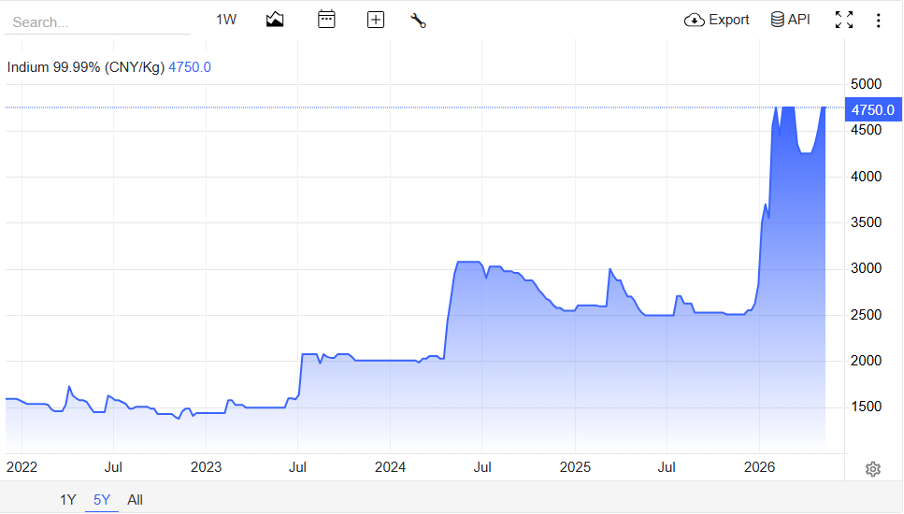
99.99% price chart – source Trading Economics
ASX Small Cap Exposure to Indium
As Western governments and technology manufacturers look to secure non-Chinese sources of critical materials, market attention often turns to safe-haven jurisdictions like Australia.
For investors seeking potential exposure to the indium thematic, Iltani Resources (ASX: ILT) provides a relevant case study. The company is currently advancing the Orient Silver-Indium Project in Northern Queensland, which stands as Australia’s largest known silver-indium deposit. The project is notably backed by an $8 million investment by the Queensland Investment Corporation (QIC).
The project holds a Maiden Mineral Resource Estimate of 62.5 million tonnes at 81.5g/t silver equivalent. Crucially, this resource includes 579t of contained indium. When compared to the global annual refined indium production of approximately 1,100t, the scale of the Orient deposit represents a significant volume of the critical mineral.
While the indium supply deficit provides a distinct critical minerals angle, Iltani’s leverage to silver is also a core component of the project. As a precious-metal-rich epithermal system, the Orient project offers exposure to both the ongoing silver market dynamics and the tightening high-tech indium sector.
Current Operations
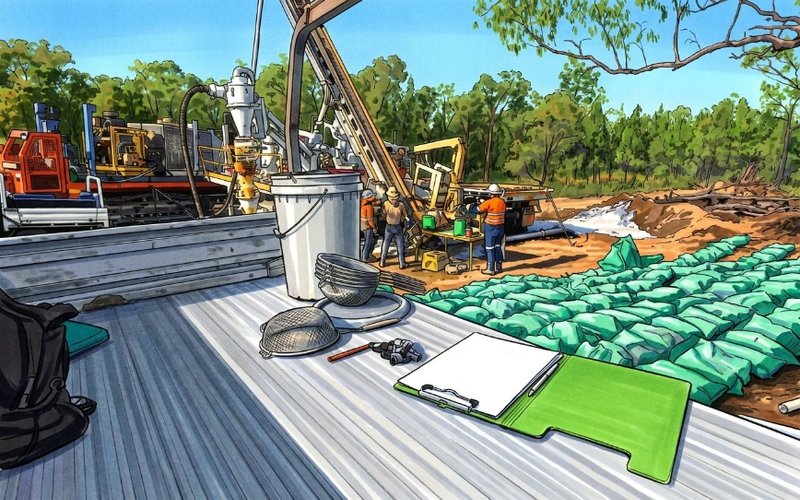
Operationally, Iltani is actively working to expand the project's footprint. The company has deployed two drill rigs for a comprehensive 115-hole, 16,000-metre reverse circulation program at Orient.
The 2026 campaign is designed to infill the resource, link the Orient East and West zones, and test new targets within the Herberton field.
With rolling assay results expected to reach the market by early June 2026, the company will likely experience steady news flow over the coming months.
For market participants tracking the macroeconomic squeeze on critical minerals like indium, exploring domestic assets like those held by Iltani offers a practical way to monitor the sector's development.
Get the wire before the market opens.
The ASX small-cap stories that matter, filed before 9am AEST. Curated by the Small Caps desk.