
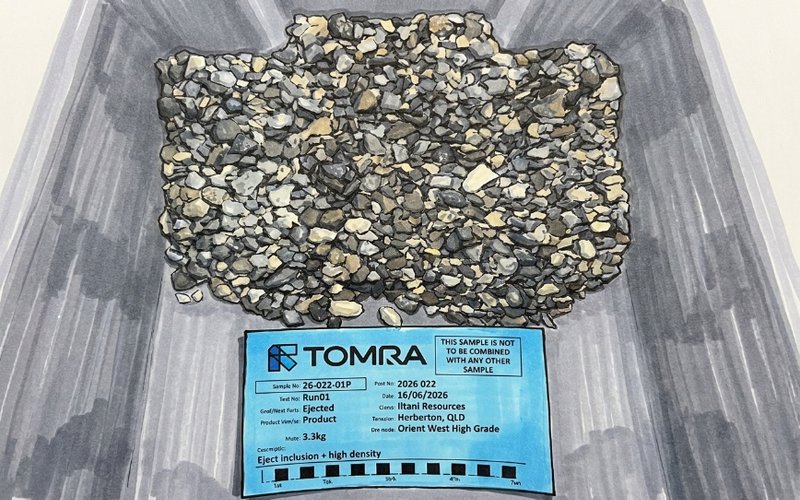

- 01XRT: Ag 265, In 427 g/t; 58% feed rejected.
- 02Low-grade: Ag 26→325, In 27→437 g/t; 96% rejected.
- 03Upgrade factor: 13.2x.
- 04Next: drill program and bulk XRT at TOMRA.
Iltani Resources (ASX: ILT) has reported successful first-pass X-ray Transmission (XRT) ore sorting results from high-grade and low-grade reverse circulation chip samples collected at its Orient Silver-Indium Project in North Queensland.
The high-grade run rejected 58% of the screened feed mass while lifting silver from 130 grams per tonne to 265g/t and indium from 199g/t to 427g/t.
The low-grade run rejected 96% of the screened feed and delivered an average upgrade factor of 13.2, increasing silver from 26g/t to 325g/t and indium from 27g/t to 437g/t.
All mass rejection figures and upgrade factors relate only to the screened 6–25mm fraction supplied to the sorter and do not represent overall mine-feed performance.
Future integrated flowsheet work will need to assess that unsorted fraction and determine representative overall performance across broader particle sizes and mineralisation styles.
Atomic Density Differences
The single-stage sorting process used atomic density differences to distinguish dense sulphide-bearing particles from the siliceous host rock, with galena and sphalerite forming the principal target minerals.
Lead in the high-grade sample increased from 1.8% to 3.6% and zinc rose from 4.3% to 9.1%, while the low-grade sample lifted lead from 0.6% to 7.3% and zinc from 0.8% to 9.3%.
Low-grade waste fractions from both tests indicate that most sulphide mineralisation reported to the product stream, supporting the potential to concentrate material before it enters the milling circuit.
Iltani considers that removing barren host rock before milling could reduce plant throughput, energy consumption, tailings storage requirements and operating costs while retaining metal units delivered to the concentrator.
A lower volume of material entering the processing circuit could also support a smaller milling circuit and tailings storage facility, reducing potential upfront capital requirements.
Significant Potential Benefits
Iltani managing director Donald Garner was particularly impressed by the upgrades to the low grade sample.
“If we can use ore sorting technology to remove a significant proportion of waste prior to the milling circuit, this will have significant benefits for the Orient project,” Mr Garner said.
“Now we know ore sorting works, we can move onto the next stage of ore sorting test work, which will involve drilling PQ diameter diamond drillholes to generate sample required for a comprehensive ore sorting test work program.”
The planned seven-hole diamond program using 85mm-diameter core will include about 700kg of bulk XRT sorting at TOMRA’s Sydney facility and evaluate results across multiple size fractions and mineralisation styles, with downstream comminution and flotation test work to then assess the sorted products and waste fractions to establish potential benefits across the full processing flowsheet.
Orient has an initial mineral resource estimate of 34.2 million tonnes at 31.3g/t silver, 16.9g/t indium, 0.74% lead, and 0.90% zinc using a 60g/t silver-equivalent cut-off, with a larger 62.5Mt MRE reported at a 30g/t cut-off.
Get the wire before the market opens.
The ASX small-cap stories that matter, filed before 9am AEST. Curated by the Small Caps desk.