

- 01Powers North & Wildcard South; Spectre confirmed.
- 02Ground work tunes drill targets.
- 03U at all three targets: Powers North, Wildcard South, Spectre.
Greenvale Energy (ASX: GRV) has defined two new prospects during a field work program across priority targets at its Thunderball uranium project in the Northern Territory.
The company’s first on-ground program undertaken within exploration licence 34157 also confirmed a third historical prospect for further review.
Initial results identified the new Powers North and Wildcard South prospects, while validating a 20-metre wide breccia zone at the historical Spectre prospect, thought to be closely associated with the southern part of the Hayes Creek Fault Zone.
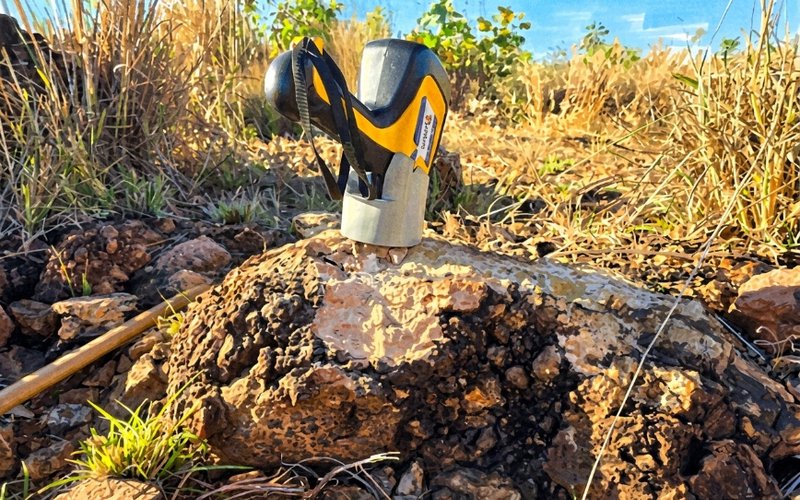
All three prospects were initially discovered through a recent airborne radiometric survey, with ground-truthing and confirmation achieved through the current mapping, sampling and field analysis campaign using a hand-held scintillometer and portable x-ray fluoresence (pXRF) analyser.
Ground-Based Geophysics
The Thunderball mapping and sampling program aims to enable smarter, more focused development and definition of targets for future drill testing.
It involves mapping all outcropping geological units and investigating anomalies through the use of ground-based geophysics, initially using an RS-125 spectrometer followed by hand-held pXRF.
After establishing the background uranium level, any areas returning uranium values more than twice the natural background were deemed as real anomalies and sampled before being submitted to Intertek for assaying.
The field-based results confirmed anomalous uranium at Powers North (defined as a palaeochannel), Wildcard South, and Spectre.
Uranium-Bearing System
Greenvale managing director Alex Cheeseman said the new prospects serve to further enhance the prospectivity of Hayes Creek as a key uranium-bearing structural system running through the centre of Thunderball.
“This is a great result from our first ground-based work program and our first few weeks in the field [and] before mobilising the field team, we had a conceptual exploration model based on remote aerial data but had minimal ground-based information,” he said.
“Our exploration strategy incorporates a variety of different techniques to enable smarter drill targeting and design and these results bring us one step closer to achieving that outcome while strongly validating the anomalies within our pre-defined target areas.”
He said the company would continue to systematically map and sample the Thunderball project area with a view to building a quality pipeline of high-confidence drill targets.
Get the wire before the market opens.
The ASX small-cap stories that matter, filed before 9am AEST. Curated by the Small Caps desk.