
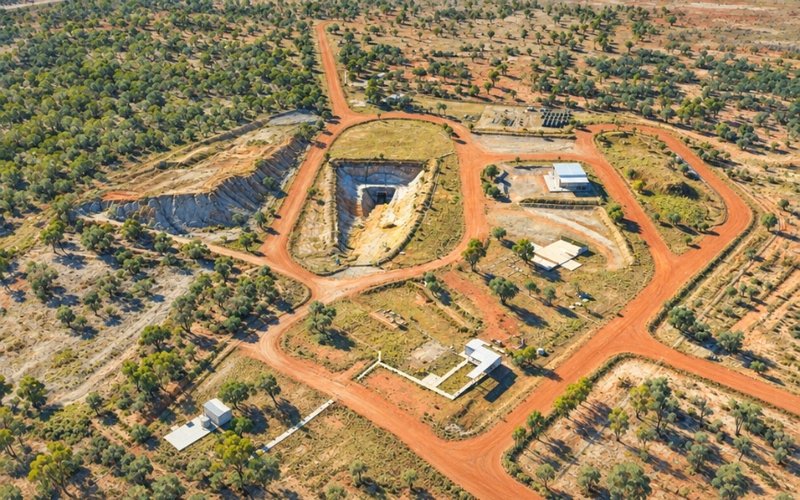

- 01GBM drills new Twin Hills gold targets.
- 02Targets extend beyond 309 and Lone Sister.
- 03Airborne EM survey underway; historic hits include 11m at 1.7g/t.
GBM Resources (ASX: GBM) has launched a drilling campaign across a series of high-priority brownfields and greenfields gold targets at the Twin Hills gold project in Queensland’s Drummond Basin.
The program represents an important expansion of the company’s exploration strategy beyond the 309 and Lone Sister deposits.
It will target prospective mineralised systems identified through the integration of historical gold intersections, recent high-resolution geophysics, and an evolving geological model.
Geochemical work has also identified arsenic and antimony as useful pathfinder elements above low-sulphidation epithermal gold mineralisation, while uranium, lanthanum, cerium, and zirconium are being assessed as indicators of prospective rhyolitic magmatism.
Major Structural Corridors
Many of the targets — including Powerline, Flying Fox, Airstrip, L7, Stella and Feilwella — are located within major structural corridors and magnetic lows interpreted to represent significant hydrothermal alteration systems.
They are supported by best historical gold intersections of 11 metres at 1.7 grams per tonne gold from 24m at Prospect, 1m at 10g/t gold from 154m and 8m at 0.83g/t gold from 150m at Airstrip, 2m at 2.52g/t gold from 44m and 1m at 1.96g/t gold from 33m at Feilwella, and 2m at 2.18g/t gold from 96m and 2m at 1.66g/t gold from 14m at Stella.
These assays are thought to occur within the same structural corridor and volcanic sedimentary basin as 309, where recent drilling returned 8m at 1.31g/t gold from 126m.
GBM has also commenced a project-wide airborne electromagnetic survey over Twin Hills partially funded by the Queensland government and designed to build on historical survey results which delineated the 309 and Lone Sister deposits.
Clearer Regional Picture
Chief executive officer Daniel Hastings said drilling to date had provided a clearer picture of the regional controls on gold mineralisation and substantially increased the number of targets that warrant testing.
“We now have high-resolution geophysics, historical drilling, and geochemistry integrated with geological knowledge gained from our recent drilling at 309, Lone Sister and Stella, which has allowed us to identify major structural corridors, alteration systems, and prospective intrusive and volcanic settings across Twin Hills with greater confidence,” he said.
“There is a large pipeline of targets and several already contain encouraging historical gold intersections, while others have strong geological and geophysical attributes but have seen little or no effective drilling.”
“We will now take the opportunity to drill test these highly promising discoveries […] while we continue to generate and rank the next group of regional targets.”
Get the wire before the market opens.
The ASX small-cap stories that matter, filed before 9am AEST. Curated by the Small Caps desk.