
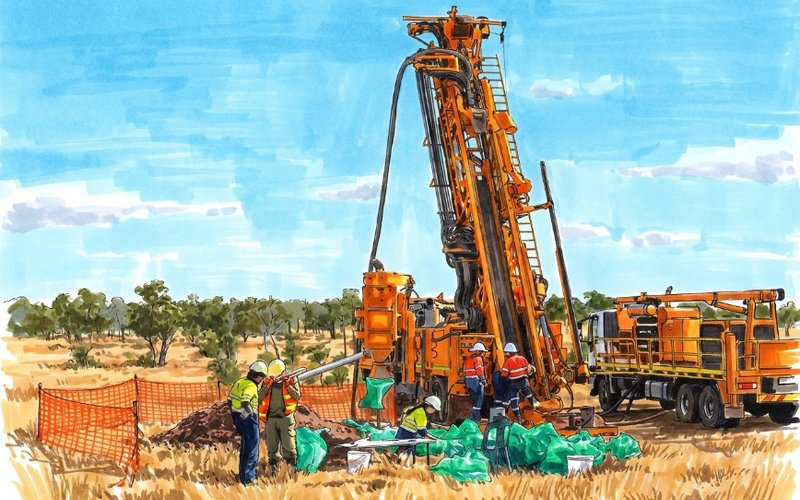

- 01BXM horizon extends 700m south of 309.
- 02Stage 2 hits outside MRE; 8m @1.31 g/t.
- 03BXM is a laterally continuous horizon.
GBM Resources (ASX: GBM) has confirmed the continuation of a prospective milled matrix breccia (BXM) host horizon at least 700 metres south of the 309 deposit, expanding the exploration footprint at its Twin Hills gold project in Queensland.
Over 25,000m of Stage 2 resource development drilling at 309 and Lone Sister returned significant intercepts outside the boundaries of the modelled mineralisation at both deposits, providing the company with encouraging early indications that the system extends beyond the current mineral resource estimate (MRE).
Drilling materially improved GBM’s understanding of the geological controls on gold mineralisation at Twin Hills, significantly increasing the wider exploration potential.
Geological interpretation indicates that the BXM is developed along a laterally continuous sedimentary horizon (rather than occurring as isolated bodies), substantially expanding the area considered prospective for additional mineralisation.
Recent high-resolution magnetic processing that identified alteration zones and intrusive centres interpreted to represent favourable pathways for mineralising fluids further support this hypothesis.
BXM Horizon Intersected
The first holes drilled within the Twin Hills tenure outside of the MRE to downhole depths of greater than 200m successfully intersected the BXM host horizon, confirming it continues beneath 309’s Coreshed prospect and extends at least 700m south towards the Stella target.
Gold mineralisation was confirmed in each hole, with assays returning 8m @ 1.31 grams per tonne gold, hosted within an interpreted brecciated structural zone.
This provides strong validation of GBM’s revised geological model and demonstrates the potential for mineralisation to extend well beyond the current resource footprint.
Assays for approximately 60% of the mineralised zone at Stella remain outstanding, and will continue to be integrated with ongoing geological, geochemical, and mineralisation vectoring studies to refine targeting and increase understanding of the controls on mineralisation across the Twin Hills corridor.
Changed Project Perspective
Chief executive officer Daniel Hastings said the improved geological understanding had changed the company’s perspective of Twin Hills.
“A significant outcome from our Stage 2 drilling program has been the recognition that much of the historical drilling across Twin Hills was simply too shallow to adequately test the prospective BXM host sequence,” he said.
“Rather than being isolated mineralised bodies, we now recognise a laterally extensive mineralised host sequence extending beyond the 309 MRE.”
“These early results reinforce our confidence that we are testing a substantially larger prospective system than previously recognised, and demonstrate the potential for mineralisation to extend beyond the current resource boundaries at Twin Hills.”
Get the wire before the market opens.
The ASX small-cap stories that matter, filed before 9am AEST. Curated by the Small Caps desk.