
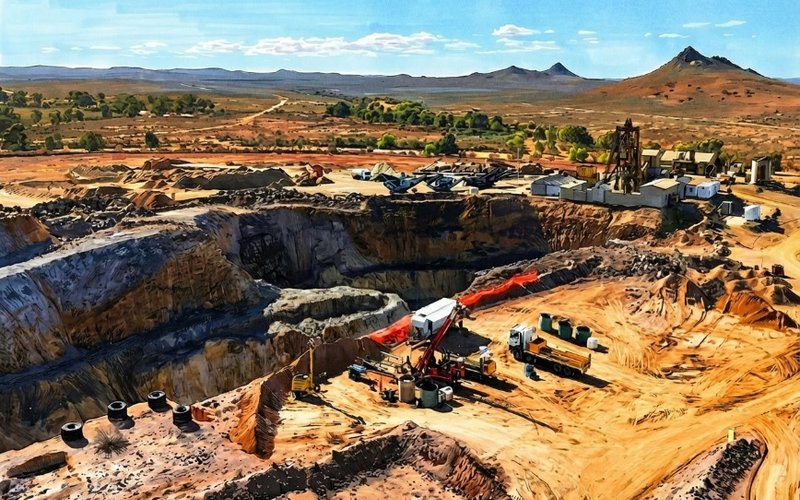
Broken Hill Mines (ASX: BHM) delivered a stronger March quarter at the Rasp mine as higher-grade feed from the Main Lode lifted mill head grades, metal production, and operating cash flow.
The company processed 115,653 tonnes of ore at an average zinc equivalent grade of 6.5%, up 29% from the December quarter, as its second feed source at the high-grade Main Lode came online and progressively increased feed availability.
That translated into quarterly silver production of 78,649 ounces (up 51.7%), lead production of 2,473t (up 48.5%), and zinc production of 3,113t (up 7.9%), alongside a 45% lift in operating cash flow to A$2.4 million.
Broken Hill Mines now expects a further material increase in ore feed tonnage from the Main Lode in the June quarter, and has also positioned the high-grade Pinnacles mine as a third feed source, with mining operations due to start during the quarter.
Rasp Ramp-Up Gains Momentum
The March quarter continued the operational ramp-up of Rasp toward 750,000tpa capacity through the staged addition of new feed sources beyond Western Min.
Improved grades came from the start of high-grade Main Lode mining and stronger ore from Western Min, with further grade gains targeted as Main Lode contribution rises and Pinnacles feed is introduced through 2026.
During the quarter, Rasp produced 6,300t zinc concentrate and 3,900t silver-lead concentrate, with payable metal sold including 2,700t zinc, 2,000t lead and 63,000oz silver.
Broken Hill Mines also completed the shift away from contractor underground development at the end of January.
The company has run internal mine development since February, with June quarter development metres expected to increase.
Cash Flow Improves as Growth Spend Falls
Sales revenue excluding quotational periods came in at A$25.5m for the quarter and actual cash receipts reached A$30.0m.
Receipts exceeded revenue as a result of inventory movements, quotational periods from prior sales, and working capital movements.
Production costs fell about 6% to A$19.0m despite higher metal output, while growth capital expenditure—primarily for Main Lode development—dropped 28% to A$10.1m as the owner-operator transition took effect.
At 31 March, the company held A$38.6m in cash and reported total available liquidity of A$75m including cash, unsold concentrate inventory, and open quotational periods, while also retaining US$7.5m undrawn under its facility with Hartree Partners.
A shift to consistent free cash generation in 2026 is being targeted as operational cash flow expands and ramp-up capital requirements continue to ease.
Pinnacles to Add Next Leg of Growth
Pinnacles completed early works and operational readiness during the quarter, and remains on track to resume mining in the June quarter as Broken Hill Mines pushes to bring the deposit into the production mix.
The company drilled about 8,000m at Pinnacles during the quarter as part of its Phase 2 program targeting open pit expansion opportunities, the Rope Shaft and Junction areas, and the high-grade Perseverance zone.
Reported results continued to highlight strong silver-lead-zinc mineralisation and broader polymetallic upside, including 5.1m at 25.9% zinc equivalent and 717 grams per tonne silver equivalent from 430m in hole PN333, with a higher-grade interval of 2.2m at 56.1% zinc equivalent and 1,556g/t silver equivalent from 432.8m.
Broken Hill Mines also pointed to near-surface intercepts close to the historical open pit, and said visual drilling around old infrastructure had indicated previously unidentified shallow mineralisation that could support expansion of planned open-pit operations.
Exploration and Expansion Studies Continue
Across Rasp and Pinnacles, Broken Hill Mines completed more than 16,500m of drilling in the quarter and has made solid progress with its 42,000m drilling program for 2026, with another 9,500m of core still being processed.
This work is intended to support mineral resource upgrades scheduled for late 2026 and to feed into mine optimisation studies at both operations.
At Rasp, front-end engineering design for the tailings dewatering plant is nearing completion, with the plant expected to remove the need for solar tailings drying and support the lift to 750,000tpa nameplate capacity from the current 500,000tpa.
The company is also assessing near-term development of an exploration decline at Pinnacles after delineating a very high-grade underground zone extending 350m down dip, up to 100m wide and typically between 2m and 10m thick, further broadening the project’s development options.
