

- 01BRE finds Pelé South rare earths, with >10% TREO from surface.
- 022.5km corridor averages 5% TREO; core drilling is testing depth.
Brazilian Rare Earths (ASX: BRE) has made an extensive rare earth and critical mineral discovery across a large-scale exploration footprint at Pelé South, nearby to the Pelé North deposit and approximately 50 kilometres from its flagship ultra high-grade Monte Alto project in Brazil’s Rocha da Rocha province.
Systematic auger drilling confirmed the major new find, intersecting thick high-grade mineralised zones exceeding 10% total rare earth oxides (TREO) from surface within a priority north-south structural corridor extending more than 2.5km along strike.
The length-weighted average grade of intercepts was 5% TREO — over twice the average grade of comparable auger drill intercepts in Monte Alto’s shallow saprolite mineralisation.
Best assays included 6m at 13.2% TREO and 12m at 10% TREO from surface, 6m at 11.4% TREO from 3m, and 8.5m at 8.6% TREO from 2m.
The majority of holes in Pelé South’s southern discovery zone ended in mineralisation at mechanical refusal, indicating further depth extension potential into fresh rock.
New Discovery District
Chief executive officer Bernardo da Veiga said Pelé South established a major new high-grade discovery district in the centre of Rocha da Rocha.
“What makes this discovery so compelling is the rare convergence of very high grades from surface, as well as valuable heavy rare earths including dysprosium, terbium, gadolinium, and yttrium, with strong scandium enrichment—all hosted within saprolite with the potential for shallow, free-dig mining,” he said.
“These exceptional results establish the Pelé district as a new growth opportunity at our large-scale rare earth and critical mineral province.”
“We are now focused on delineating the extent and continuity of the near-surface mineralisation and drilling for potential high-grade hard-rock mineralisation beneath it.”
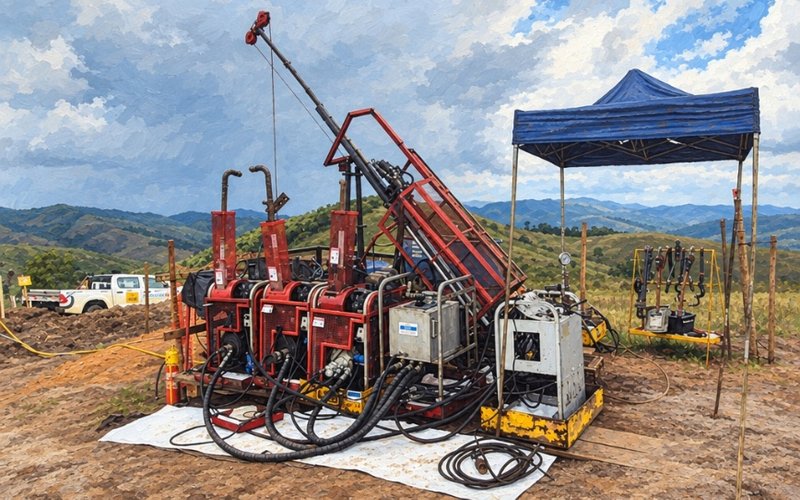
Angled diamond core rigs are now drilling directly beneath the strongest radiometric peaks and TREO auger zones to test primary hard-rock grade, true thickness and down-dip continuity.
Geophysics-Led Approach
The Pelé South discovery demonstrates the effectiveness of Brazilian Rare Earth’s systematic, geophysics-led exploration approach across the Rocha da Rocha province.
Following the identification of a prominent airborne radiometric anomaly, the company completed a high-density ground gamma-ray spectrometry survey comprising more than 5,500 measurement stations across 1.6 square kilometres.
The survey delineated a coherent high-intensity radiometric trend extending for more than 850m over a width of 50m, with an interpreted cross-cutting structural offset near its centre.
Vertical auger drilling along the trend returned high-grade rare earth intersections at the locations tested, providing a strong basis for further exploration of the shallow mineralisation and underlying bedrock.
Brazilian Rare Earths is now advancing two priorities in parallel across the Pelé prospect with a view to increasing high-grade feed options for its planned rare earth refinery hub at the Camaçari Petrochemical Complex in Bahia, approximately 260km northeast of Monte Alto.
Get the wire before the market opens.
The ASX small-cap stories that matter, filed before 9am AEST. Curated by the Small Caps desk.