

- 01Overland: new Nb-REE carbonatite system.
- 0219m @ 0.61% TREO from 86m; open.
- 03Max 1.16% TREO and 0.53% Nb2O5; heavy REE present.
Australian Rare Earths (ASX: AR3) has identified a new niobium and rare earth mineral system at its 100%-owned Overland project in South Australia.
Drilling at the R254 prospect intersected 19m at 0.61% total rare earth oxides (TREO) from 86m to the end of the hole, with the mineralisation remaining open at depth.
The interval contained zones grading up to 1.16% TREO and 0.53% niobium pentoxide, together with elevated titanium, iron, barium, and thorium.
Australian Rare Earths has interpreted the geochemical and mineralogical signature as consistent with a carbonatite system, potentially opening a new critical minerals opportunity alongside Overland’s existing uranium targets.
Unexpected Discovery
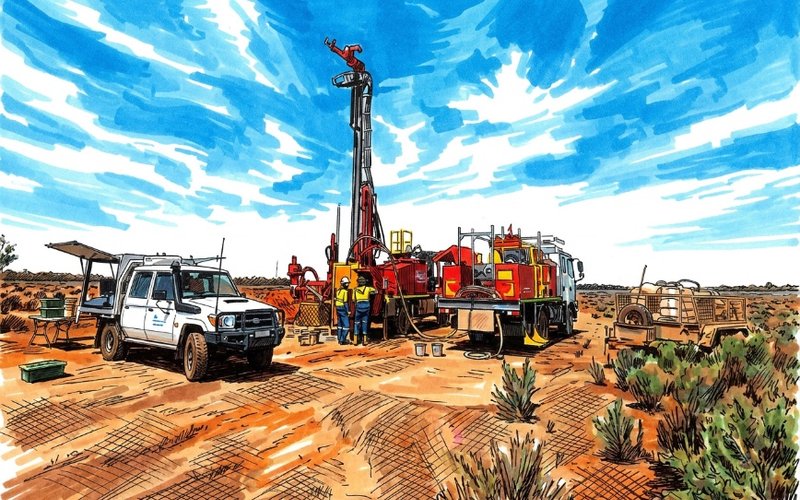
The discovery emerged from a 22-hole aircore program originally designed to test two large sedimentary-hosted uranium targets near Sedan.
While the program identified anomalous uranium accumulation within the sedimentary sequence, it did not return significant uranium intersections.
One hole continued into basement beneath a large coherent magnetic anomaly and encountered anomalous niobium and rare earth mineralisation over its final 19m.
The hole ended at 105m in mineralised basement, leaving the system untested below the current drilling depth.
High-Value Rare Earth Mix
The broader intersection averaged 0.61% TREO, with neodymium and praseodymium oxides accounting for approximately 20% of the rare earth content.
Dysprosium and terbium oxides represented approximately 1.7% of the TREO, adding exposure to heavy rare earth elements used in high-performance permanent magnets.
The upper portion of the mineralised interval returned 7m at 0.56% TREO and 0.27% niobium pentoxide, including a 1m zone grading 1.0% TREO and 0.53% niobium pentoxide.
A separate 3m zone averaged 1.16% TREO, while mineralisation continued through the remaining basement interval to the end of the hole.
Untested Magnetic Target
Australian Rare Earths considers the large magnetic anomaly beneath the discovery an immediate follow-up target.
The company’s working model is that drilling may have intersected the margin of a larger untested carbonatite intrusion.
Carbonatite systems can extend across kilometre-scale areas through intrusive bodies, dykes, sills, alteration halos, and weathered zones above the primary mineralisation.
Australian Rare Earths will expand its magnetic and gravity modelling to refine the size, geometry, and location of the prospective intrusive system, with detailed petrographic and mineralogical assessments to be followed by targeted reverse circulation and diamond drilling.
The program will test the extent and source of the magnetic anomaly, along with the potential for a larger nearby carbonatite body, while exploration will also assess whether weathering has produced shallow supergene enrichment of niobium and rare earths above the primary basement system.
Critical Minerals Exposure
Chief executive officer Travis Beinke said the discovery represented an unexpected expansion of the company’s critical minerals exposure.
“Importantly, this is not just a geochemical anomaly—the intersection includes elevated rare earths, niobium, titanium, and iron, together with petrographic and SEM evidence identifying pyrochlore, the principal niobium ore mineral globally,” Mr Beinke said.
“Our current geological interpretation is that the hole may have intersected a dyke or sill expression peripheral to a larger carbonatite intrusive centre, which remains untested and represents the company’s next drilling target.”
Mr Beinke cautioned that the result came from a single drill hole and required systematic follow-up work, while confirming that development of the flagship Koppamurra rare earths project remained Australian Rare Earths’ top priority.
Get the wire before the market opens.
The ASX small-cap stories that matter, filed before 9am AEST. Curated by the Small Caps desk.