
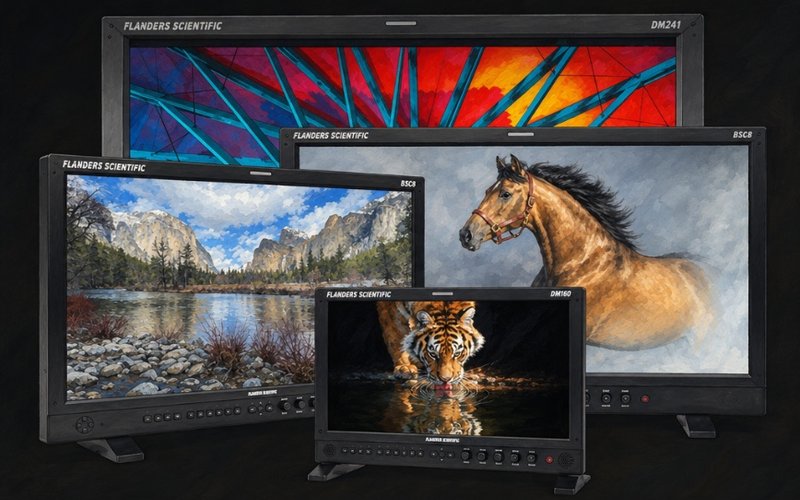

- 01Atomos launched seven lower-cost FSI QD-OLED monitors.
- 02VP prices are up to 30% lower, V up to 48% vs XMP.
- 03Shipping starts this month; FSI now has four tiers.
Atomos Limited (ASX: AMS) has launched seven professional reference monitors through its Flanders Scientific (FSI) brand, extending its offering to production customers seeking lower-priced alternatives to its flagship displays.
The new VP Series and V Series use the same quantum dot organic light-emitting diode (QD-OLED) panels, colour technology, and calibration capabilities as the existing XMP range, but provide fewer specialised features.
Prices are as much as 30% below comparable XMP monitors for the VP Series, and up to 48% lower for the V Series, with shipping scheduled to begin this month.
The release, made available to FSI customers on 5 November US time, represents the largest single product launch in Atomos’ history and adds to its existing ranges.
Different Workflow Targets
The four-model VP Series is designed for post-production facilities that require professional video connections and accurate colour reproduction without every tool included in the flagship monitors.
Its models offer serial digital interface (SDI) connectivity alongside high-definition multimedia interface (HDMI) and DisplayPort inputs, with quad-input viewing and a 120-hertz refresh rate.
Customers retain FSI’s GaiaColor AutoCal and GaiaColor Analyzer functions, while optional stereoscopic three-dimensional viewing adds a capability not offered in the XMP Series.
The three-model V Series removes professional SDI connections and instead targets visual effects, animation, game development, editing, and audio post-production environments using HDMI or DisplayPort.
This allows facilities to use higher-specification XMP or VP monitors in their primary grading suites while fitting other workstations with lower-cost V Series displays.
Pricing Expands Options
Comprising the VP270, VP310, VP551, and VP651, the VP Series spans screen sizes from 26.5 inches to 65 inches and US prices from $7,995 to $17,495.
The V270, V310, and V550 range from 26.5 inches to 55 inches, with listed US prices between $5,995 and $12,495.
Across the seven models, peak luminance ranges from 1,000 to 4,000 nits for the VP range and from 1,000 to 2,000 nits for the V range.
The additions give FSI four tiers of QD-OLED reference monitoring, encompassing V, VP, XMP C, and XMP, differentiated by their connections and onboard tools rather than their underlying colour technology.
Demand Drives Strategy
Atomos expects the more accessible pricing to attract customers who need reference-grade image quality but cannot justify the cost or features of the flagship XMP monitors.
“We have seen strong interest from customers who want FSI reference quality but do not necessarily require the full feature set of our flagship XMP range,” managing director Peter Barber said.
“By offering the same exceptional image quality, colour accuracy and calibration capabilities at a more accessible price point, we are making it possible for customers to equip more workstations, more editing suites, and more production environments with professional reference monitoring, opening up a significantly broader market for FSI.”
Both XMP and XMP C remain in full production, and Atomos is continuing to invest in product development despite what Barber described as “challenging” market conditions.
Get the wire before the market opens.
The ASX small-cap stories that matter, filed before 9am AEST. Curated by the Small Caps desk.