

- 01Target 6: 800m x 200m zone; Target 5 extends 1,500m x 200m.
- 02Chisebuka drilling to support resource update; assays pending.
- 03Grades based on gamma readings.
Atomic Eagle (ASX: AEU) has defined a new uranium-mineralised zone and extended another at its Muntanga project in Zambia following a broad 2026 exploration campaign.
Follow-up drilling expanded Target 5 to approximately 1,500 metres by 200m, while Target 6 now contains a separate zone measuring about 800m by 200m.
The discoveries add to a regional program testing eight targets at Muntanga North and two at Namakande, although the results remain at the exploration stage.
With that campaign largely assessed, Atomic Eagle is redirecting drilling towards Chisebuka to support a revised mineral resource estimate and updated development studies.
The planned MRE could include upgrading suitable material into the Indicated category where drilling density and geological continuity provide sufficient confidence.
Two Zones Take Shape
At Target 5, follow-up drilling traced a shallow-dipping mineralised horizon broadly parallel to the host rock layers, with geological structures potentially influencing its distribution.
Target 6 produced a coherent zone averaging roughly 3m in thickness and remaining open at its interpreted boundaries, although further assessment will be needed to determine whether additional drilling is warranted.
Notable Target 6 results included 5.2m at 380 parts per million equivalent uranium oxide from 38.8m and 10.9m at 250ppm equivalent uranium oxide from 36.8m.
The results are derived from downhole gamma measurements rather than laboratory assays, with radiometric readings converted into estimated uranium grades using calibrated equipment and project-specific factors.
Atomic Eagle considers the near-vertical drill intersections approximately representative of true widths because the mineralised layers dip gently, but further verification work remains necessary.
Regional Drilling Refines Targets
Since its September exploration update, the group has drilled 84 holes covering 8,367m across Targets 5 to 8, taking regional drilling at Muntanga North and Namakande to 216 holes totalling 21,829m during 2026.
However, Targets 1 to 4, 7, and 8 produced no significant uranium mineralisation, despite radiometric anomalies identified at surface during the targeting program.
Atomic Eagle interprets some of those responses as potentially reflecting the movement of radioactive material along fractures and rock layers rather than substantial mineralisation immediately beneath the anomalies.
The unsuccessful holes will inform the geological model, but management does not currently consider them sufficient grounds for follow-up drilling at those particular targets.
Chisebuka Diamond Program
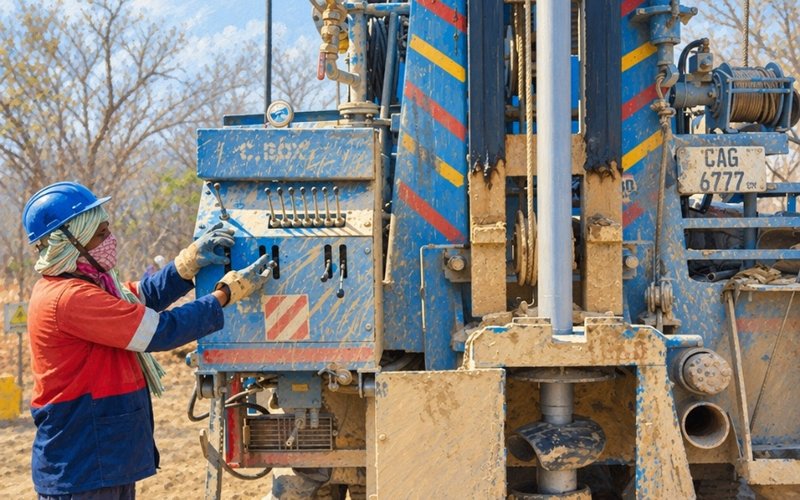
Infill and extension drilling has resumed at Chisebuka, where 12 reverse circulation holes have been completed to check grades inferred from gamma logging, with laboratory assays still pending.
A further 25 diamond drill holes are planned to provide samples for assays and metallurgical test work, alongside additional down-the-hole drilling to evaluate known mineralisation and selected extensions.
“The 2026 program has tested a broad portfolio of regional targets and continued to identify uranium mineralisation across the Muntanga licences, [and] has added materially to our geological understanding,” chief executive officer Phil Hoskins said.
“At several targets, drilling at the centre of coincident radiometric and soil anomalies intersected evidence of uranium mobility or mineralisation indicating that additional mineralisation may occur nearby along strike, down dip or beneath cover—these interpretations will be tested in future exploration campaigns.”
Atomic Eagle will integrate the regional drilling results with geological, structural, and radiometric datasets before deciding which Muntanga North targets merit further resource-definition work.
Get the wire before the market opens.
The ASX small-cap stories that matter, filed before 9am AEST. Curated by the Small Caps desk.