
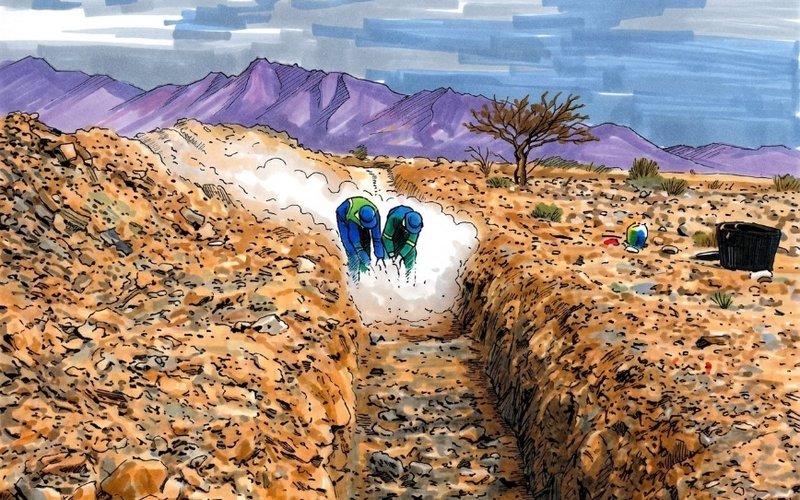

- 01Phase 1 trenching at K9 confirms polymetallic mineralisation.
- 02Best hits: 1m @2,280ppm Sn; 0.82m @0.29% Li2O.
- 03Drilling plan set for H2 to grow mineralisation.
Askari Metals (ASX: AS2) has reported positive Phase 1 trenching assays from the K9 pegmatite target at its wholly owned Uis project in Namibia, further underscoring the project’s breakout polymetallic potential.
The results confirm extensive mineralisation across tin, lithium, tantalum, rubidium, and caesium, strengthening the company’s confidence in K9 as a high-priority drill target within a rapidly emerging critical minerals district.
In several areas, the mineralisation tenor compared favourably with nearby known deposits, reinforcing K9’s growing potential as a meaningful polymetallic target.
The program, which built on earlier reconnaissance work including mapping and surface sampling, represents the first systematic test of the target.
Testing LCT Systems
Phase 1 trenching sought to systematically test the OP, PS, DP, and K9 pegmatite targets.
The four display key characteristics of fertile lithium-caesium-tantalum (LCT) systems including strong fractionation and zonation, along with lithium-associated minerals such as sugary and cleavelandite albite, coloured tourmaline, and green mica.
Askari completed a total of 135 trenches for 7,269m to generate 2,098 channel samples, with 38 trenches for 781.7m and 199 samples at K9.
Best K9 intercepts were 1m at 2,280 parts per million tin from 22m, 0.62m at 1,020ppm tin from 4m, and 0.82m at 0.29% lithium oxide from 6.68m.
Other notable hits included 1.1m at 0.29% lithium oxide from 2.80m, 3.26m at 0.18% rubidium oxide from 20.73m including 2m at 0.23%, and 0.60m at 125ppm caesium oxide from 9.32m.
Polymetallic K9 Potential
Previous field work at the K9 target returned high-grade surface values of up to 0.27% tin oxide, 216ppm tantalum pentoxide, and 0.49% rubidium oxide.
Askari sees this as a strong indication of the target’s polymetallic potential, which has been materially strengthened by the Phase 1 trenching.
The latest results have significantly improved Askari’s geological understanding of the pegmatite system, defining its strike extent, width, and polymetallic tenor with far greater certainty.
The scale and continuity outlined by trenching strongly supports the company’s planned follow-up drilling campaign in the second half of this year.
‘Fertile Mineralised Corridor’
Askari executive director Gino D’Anna said K9 was shaping up to be a “standout polymetallic discovery” at Uis.
“These results materially de-risk drilling and strengthen our conviction that K9 sits within a fertile, high-quality mineralised corridor with the scale and commodity mix to capture strong investor attention,” he said.
“In a strong tin and critical minerals market, we believe Uis is increasingly well positioned to deliver meaningful value as our exploration momentum builds.”
The company is now planning its next phase of exploration to advance and expand the known tin, tantalum, and broader polymetallic mineralisation across the project.
Get the wire before the market opens.
The ASX small-cap stories that matter, filed before 9am AEST. Curated by the Small Caps desk.