
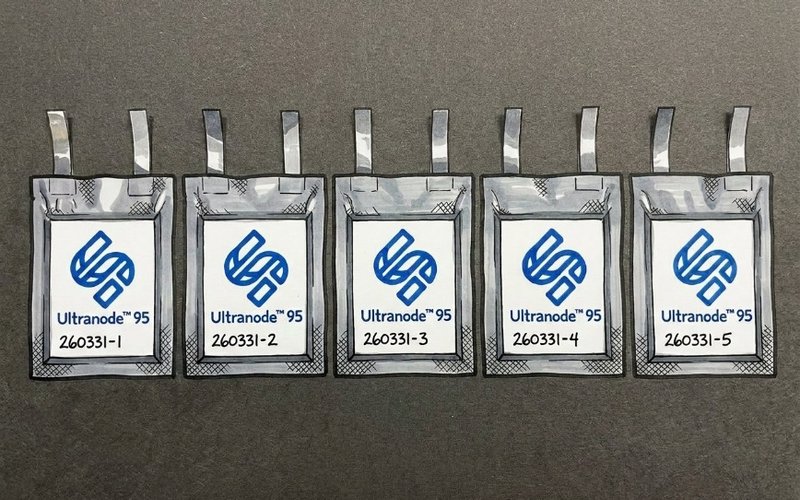

- 01Ultranode 95 validated in 5Ah MLP cells by BIC.
- 02Energy density >40% vs traditional anodes.
- 03300+ cycles at 70% retention; exceeds drone targets.
AnteoTech (ASX: ADO) has completed independent third-party validation of its Ultranode 95 high-silicon lithium-ion battery anode formulation in 5Ah (amps per hour) multi-layer pouch (MLP) commercial cells at the US-based Battery Innovation Centre (BIC).
The MLP configuration can enable more than 390 watt-hours per kilogram (squared) at battery cell level, representing specific energy density more than 40% higher than traditional anodes, enabling access to energy with significantly reduced weight and volume.
Ultranode 95’s combination of battery cell characteristics makes it suitable for applications that require powerful, lightweight batteries.
These include drones and unmanned aerial vehicles (UAV), as well as robotics, medical devices, and consumer devices including laptops.
Performance Targets Exceeded
Independent testing—which commenced at the BIC in January—achieved more than 300 cycles at 70% capacity retention, exceeding performance targets for many defence drone applications of 200 cycles.
A key objective was to incorporate Ultranode 95 into commercial-format 5Ah MLP cells (comparable to the capacity used in Apple’s current iPhone 17) suitable for drone and broader high-performance battery applications as well as cylindrical format cell production.
“From a broader technology assessment perspective, Ultranode 95 technology was successfully scaled up and represented one of the most straightforward scale-up efforts observed by BIC,” an independent report said.
“In particular, the combination of strong first-cycle efficiency, stable cycling performance, and successful scale-up from single layer to MLP cell formats provides strong confidence in the manufacturability and scalability of the technology.”
Commercialisation Pathway
AnteoTech chief executive officer Merrill Gray said demonstrating that Ultranode 95 could be commercially scalable was an important step towards commercial deployment.
“This is an important milestone in our scale-up and commercialisation pathway—it supports our ongoing engagement with US drone battery manufacturers and demonstrates the manufacturability and performance potential of Ultranode 95 in commercial battery formats,” she said.
“We are also excited to be engaging with Australian drone and battery ecosystem participants regarding potential future testing and integration opportunities involving Ultranode 95 cylindrical cells, based on the highly-positive BIC test results.”
AnteoTech is also pursuing future cell evaluation programs with companies that supply drones, drone-related systems, and UAVs to the Australian defence sector.
Get the wire before the market opens.
The ASX small-cap stories that matter, filed before 9am AEST. Curated by the Small Caps desk.